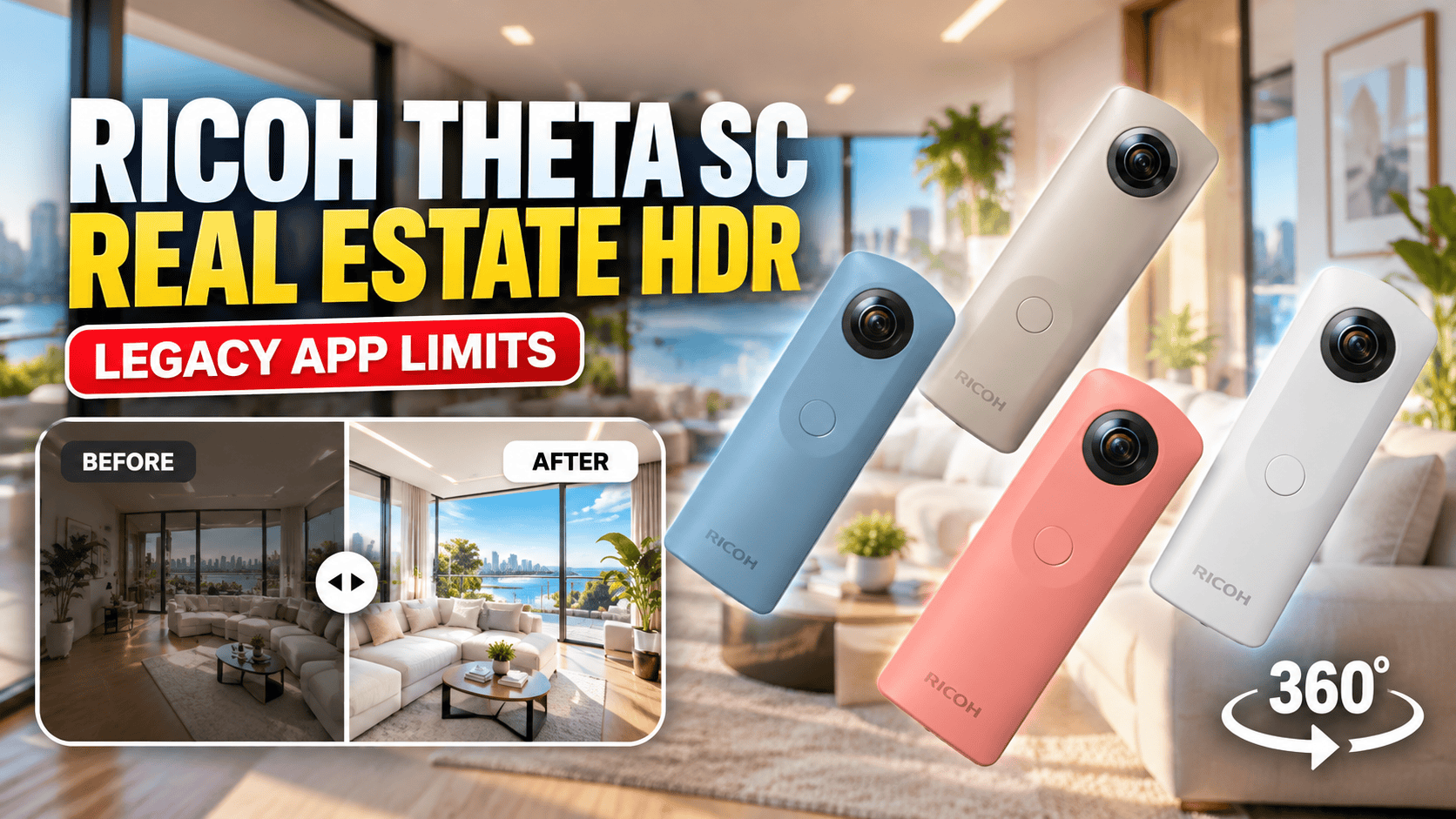
Ricoh Theta SC for Real Estate: HDR & Legacy App Limits
Legacy camera guide · Real-estate still photography
An existing Theta SC can be a useful way to learn spherical property photography. Buying one for business today is a different decision: prove that you can control the camera, retrieve full-size images and deliver a reliable tour before judging it by its second-hand price.
Our assessment
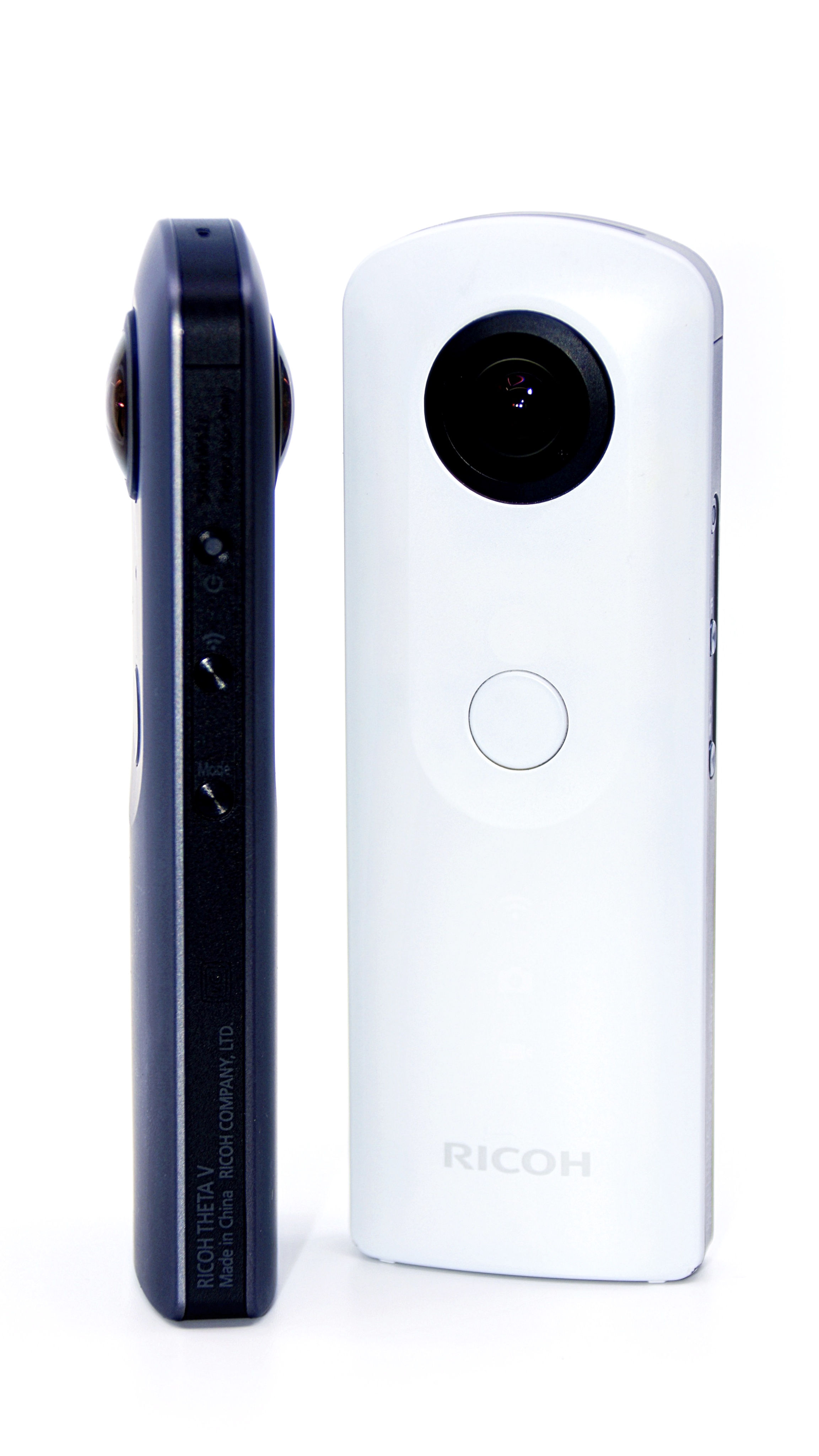
The strongest case is continued use of a working kit whose output already meets the client's needs. The weakest case is an untested purchase intended to become the foundation of a paid service immediately. Camera condition and software access are both part of the product you are effectively buying.
For a real-estate tour, demonstrate a complete room sequence, not a single attractive outdoor panorama. Evaluate bright windows, shadowed corners and the transition between rooms. A low purchase price does not compensate for an unreliable capture process or an export that requires excessive correction.
Check app access before buying
Ricoh's September 2026 notice excludes the Theta SC from successor RICOH360 app compatibility. From November 1, 2026, new installations of the discontinued THETA app on Android 15 or later are restricted where the user lacks qualifying prior-installation access through their Google account. Existing installations are not automatically disabled, but future OS compatibility is not guaranteed.
Our interpretation for a business buyer: ask the seller to demonstrate the precise controls you need, then establish access on your own device. A seller's working phone does not prove that your new phone will support the same workflow. Do not confuse the SC with the later SC2 when reading app compatibility lists.
Still-photo specifications
| Feature | Specification |
|---|---|
| Large / small still | 5376 × 2688 / 2048 × 1024 pixels |
| Sensors / aperture | Two 1/2.3-inch CMOS sensors; f/2 |
| Photo ISO | 100–1600 |
| Exposure control | Auto, shutter priority, ISO priority and manual |
| Manual shutter | 1/8000 second to 60 seconds |
| Storage / battery | Approximately 8 GB internal; built-in lithium-ion battery |
Source: Ricoh's SC specification page. The original battery specification is not evidence of remaining battery health in a used unit.
Preserve the large original
Horizontal samples across the complete panorama
Large — 5,376 pixels
Small — 2,048 pixels
Our recommendation is to retain the large capture as the master and create smaller delivery copies only when needed. In a virtual tour, the viewer examines part of the sphere at a time. Test the expected viewing angle and zoom; the appearance of a small flattened preview is not enough to judge the experience.
HDR, manual exposure and the restart trap
The official shooting-controls guide documents noise reduction, DR correction and HDR rendering in Auto. It recommends securing the camera on a tripod for noise reduction or HDR. Manual mode controls shutter, ISO and white balance. Crucially, the camera returns to Auto when powered on, and shooting-condition settings are retained only until power-off or reconfiguration.
For a room sequence, our suggested checklist includes rechecking the mode after every restart. Otherwise, two adjacent rooms may have been photographed under different assumptions. Confirm the settings on the control device, make a test frame and review it before continuing.
Start your comparison in a room with a bright window and dark furnishings. Compare an ordinary capture with HDR, inspecting the window boundary and any moving subjects separately. Do not assume that making shadows brighter means that highlight detail has been preserved. Keep people, swinging doors and changing displays out of a multi-exposure trial where practical.
For dim, static spaces, manual control gives you another capture strategy to evaluate. A long exposure needs a stable support and an undisturbed scene; it is not a solution for moving workers or visitors. Wait for capture completion before moving or switching off the camera.
What an owner's review adds—and what it does not
The 2017 first-hand review on Monochrome, updated in 2018, valued the compact camera's creative possibilities but characterized image quality as more appropriate for mobile snapshots than demanding technical use. The owner also described wireless dropouts when hiding behind obstacles to stay out of the photograph.
That is useful historical context, not a current camera ranking. Some operational details in old reviews can also become outdated: for example, Ricoh's archived manual now explicitly includes camera-only self-timer instructions. We rely on model-specific documentation for capabilities rather than transferring every limitation reported in an early review into present-day buying advice.
A second perspective comes from Mic Ty's November 2017 collaboration with Ben Claremont. Ben included Theta SC among his lower-budget photography recommendations. Mic preferred Mi Sphere for resolution, edge-to-edge sharpness and dynamic range. That disagreement is useful context: SC was a credible accessible option in its era, not an uncontested image-quality leader. Their historical price bands are not current buying prices, and neither recommendation accounts for the 2026 Android distribution change above.
Camera-only timer: useful, but not an app replacement
Ricoh's SC self-timer instructions say to hold the wireless button while powering on, position the camera, then press the shutter. The default countdown is five seconds. The same page warns that date and time are inaccurate if the camera has never connected to a smartphone.
For an empty room, a timer can help you step out of view without depending on a live remote connection for the shutter press. It does not establish access to the app's exposure controls. Before a paid visit, confirm both the required settings and the recorded timestamp; for construction records, retain a separate visit log rather than relying on unverified file dates.
USB transfer and a level horizon are separate checks
Ricoh's SC import instructions document USB retrieval using Windows device-file access or Photos/Image Capture on Mac. They also warn that imported images are not corrected for slant, even though the computer application corrects their displayed view.
Our delivery process would therefore preserve the original, inspect the sphere, check the exported horizon and test the hosted result. Seeing a level image in one application is not proof that all viewers will interpret it the same way. Confirm privacy edits and the default viewing direction after upload, not only in the editor.
GoThru operates this publication. We have not performed an SC-specific export/upload test for this guide, and no platform compatibility guarantee is implied.
Construction documentation and occupied businesses
For an existing working SC, a useful trial is a small, repeatable set of room viewpoints. Record location, date and camera height, and note areas missed because access changed. Keep close scaffolding and temporary partitions under particular scrutiny at the stitch boundary. Supplement the panorama with detail photographs where the overview cannot show enough.
A still-photo HDR workflow is most useful when the scene can remain static. Schedule capture around site activity rather than expecting moving workers to disappear cleanly. For an occupied office or shop, check every direction for people, documents, screens and reflections before sharing.
Ricoh's SC handling guidance warns against getting the camera wet and notes reduced battery duration in cold conditions. Plan dry, protected capture rather than treating this as a rugged site camera. This guide establishes no hazardous-location certification. A visual progress record is also not a measured survey, BIM alignment or automatic defect report. Match the capture plan and distribution permissions to the actual purpose of the record.
Travel use and the final buying checklist
For travel, test charging, remote control and retrieval before departure. A familiar old camera may still support enjoyable destination stories; discovering that a replacement phone cannot control it can undo that advantage. Owner-operated Panorra provides a related panoramic storytelling context, not evidence of tested SC integration.
Before buying, inspect both lenses, test battery endurance over a representative session, retrieve full-size originals and prove control on your own phone. If any essential stage fails, compare the cost of a supported replacement with the time needed to preserve a legacy setup. Judge the finished tour and workflow, not simply the camera body's asking price.
Compare the limitation you need to solve
| Priority | Relevant guide |
|---|---|
| Understand another legacy Theta | Theta S: review its own controls and software limitations; it is also excluded from the successor app. |
| Successor-app access | Theta V: Ricoh lists V as supported by RICOH360, unlike SC. Still verify the functions your job needs. |
| More editing flexibility for interiors | Theta Z1: compare RAW/HDR processing and delivered window detail, including editing labor. |
| A still-focused room workflow | Theta X: examine capture convenience and processed panoramas at your required viewing scale. |
These are decision paths, not results of our own head-to-head test. Include camera condition, software access, mounting, capture time and delivery work in the comparison.
Research checked 21 September 2026. No hands-on rating or original image-quality measurements assigned.


Comments ()