QooCam 3 vs Ricoh Theta X: Specs, RAW Workflows and Tours
Technical comparison · Interior tours, construction and travel
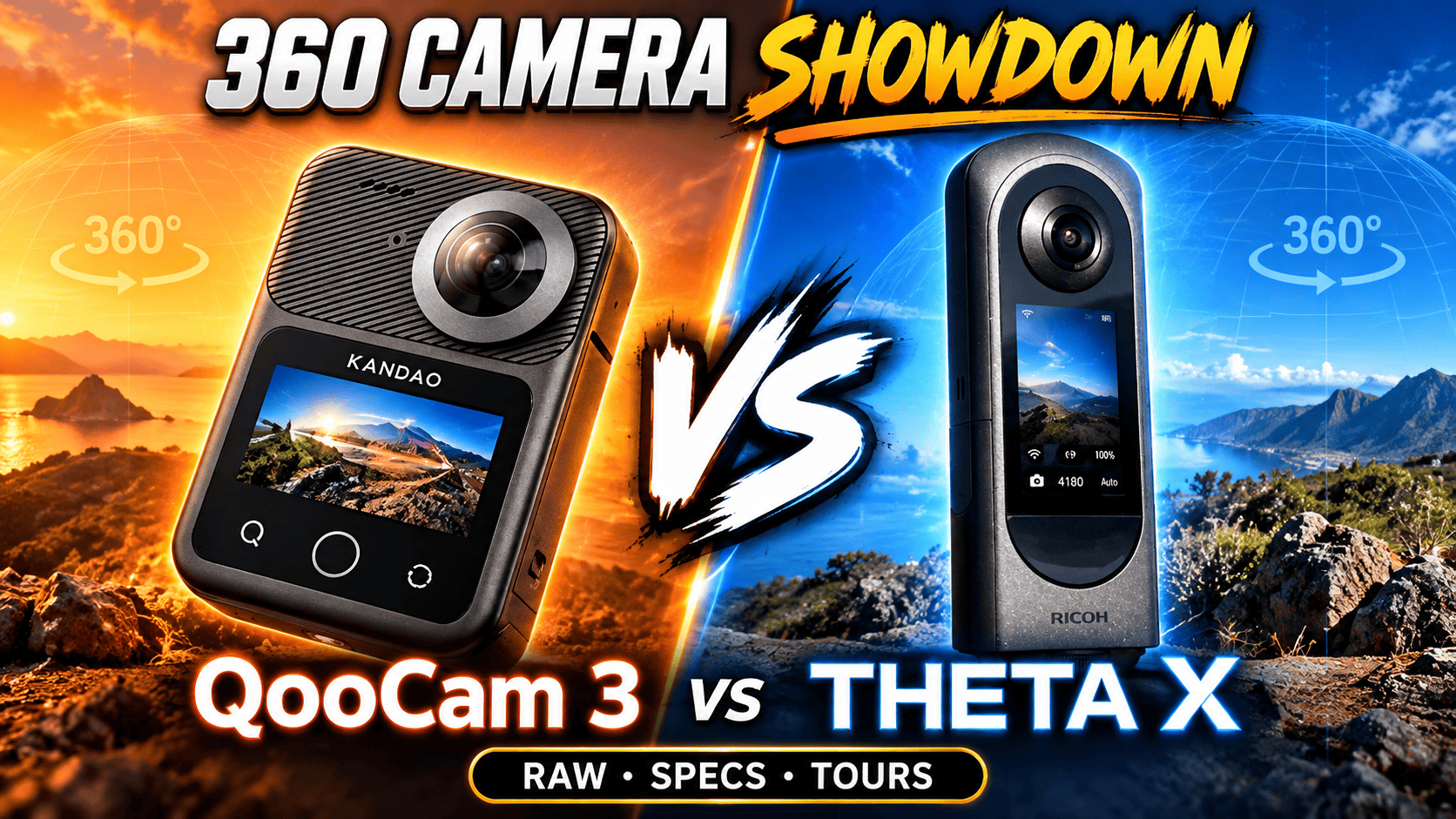
These cameras produce similarly sized maximum panoramas, but that hides different capture and processing choices. QooCam 3 offers ordinary DNG capture and a DNG8 workflow. Theta X combines standard JPEG capture with a separate official HDR-DNG plug-in, internal storage and a larger touchscreen. Compare the finished job, not just 62 versus 60 megapixels.
Which workflow should you shortlist?
For an established JPEG tour workflow, investigate Theta X first. Its standard still capture, touchscreen and internal recording capacity make it a relevant option when quick, repeatable delivery matters. This is a workflow recommendation to test, not a measured claim that it is faster than QooCam on every job.
For photographers who want control over DNG processing, investigate QooCam 3 alongside Theta X's HDR-DNG mode. QooCam's DNG8 and Theta X's four-frame HDR-DNG are not interchangeable capture methods. Evaluate a difficult window scene using the exact software route you intend to keep, including any extra merge and stitch steps.
For mixed photo/video travel assignments, look at frame rates before resolution badges. QooCam supports 24/25/30 fps at 5.7K and a single-lens mode. Theta X lists 8K only at 10 or 2 fps; that is not an 8K30 action-video alternative. Neither camera gets a universal win from this specification alone.
Sensors, exposure and panorama dimensions
| Parameter | QooCam 3 | Theta X |
|---|---|---|
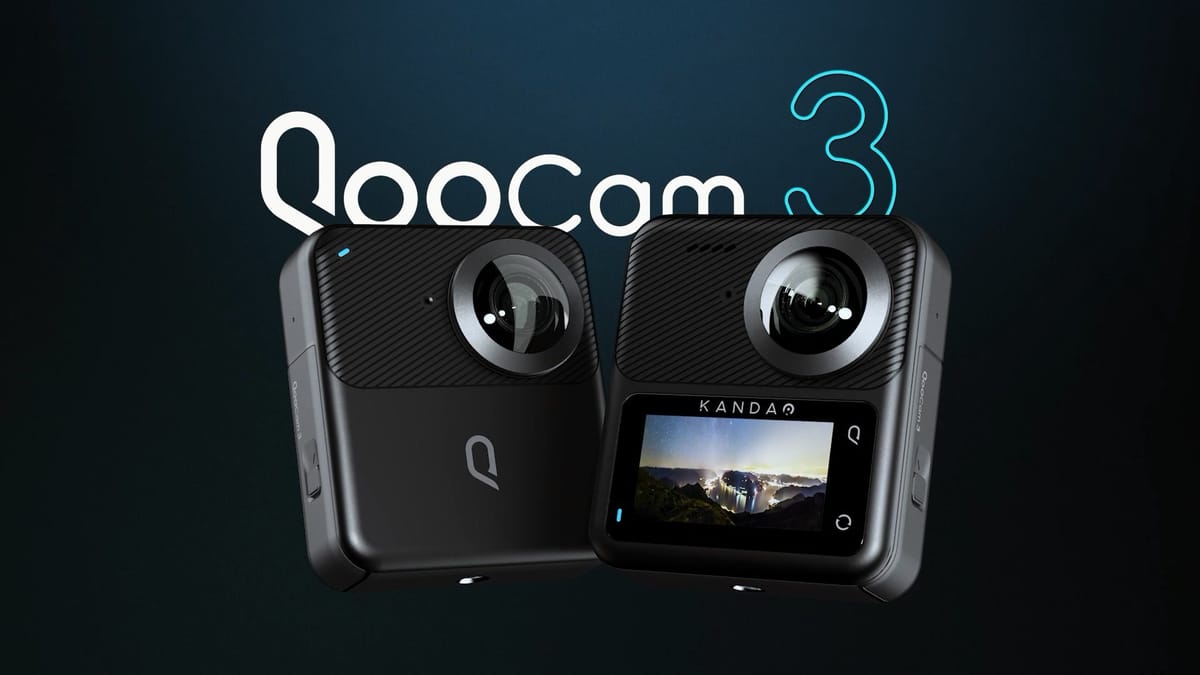
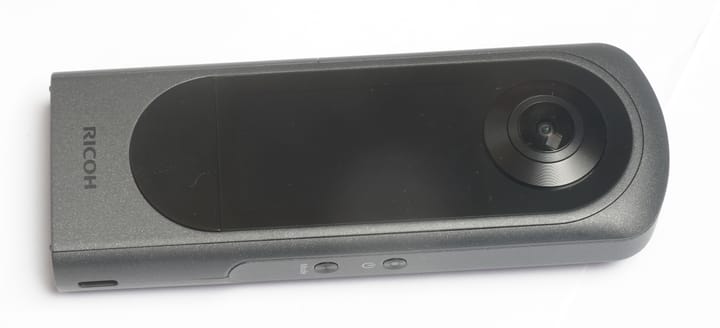
| Sensor format | 1/1.55-inch type | Dual 1/2-inch type |
| Aperture | f/1.6 | f/2.4 |
| Maximum panorama | 11136 × 5568; 62 MP | 11008 × 5504; 60 MP |
| Smaller listed photo | Not specified in cited technical table | 5504 × 2752; 15 MP |
| Ordinary formats | JPEG, DNG | JPEG; separate HDR-DNG plug-in |
| ISO | 100–6400 | 50–3200 |
| Manual photo shutter | 1/6400–60 sec | 1/16000–60 sec |
| Exposure compensation | ±2 EV | ±2 EV; 1/3-EV steps |
| White-balance temperature | 2500–8000 K | 2500–10000 K |
References: QooCam 3 specifications and Theta X manual. A larger sensor-format label or wider aperture does not establish measured noise or dynamic range. Test equally bright, equally sized finished images before drawing an image-quality conclusion.
Maximum listed panorama width
QooCam 3 — 11,136 pixels
Theta X — 11,008 pixels
DNG8, JPEG and HDR-DNG are three different routes
| Route | Capture | Processing |
|---|---|---|
| QooCam 3 DNG8 | Eight DNG captures | Raw+ merge, RAW development, then Studio stitching in the linked guide |
| Theta X standard | JPEG; HDR rendering and handheld HDR listed | Inspect the camera-produced panorama in the intended viewer |
| Theta X HDR-DNG | Four RAW captures processed to a 16-bit HDR-DNG | Develop dual-fisheye JPEG/TIFF, then use THETA Stitcher |
Ricoh's official plug-in page specifies firmware 2.61.0 or later for installation. Its September 2024 procedure distinguishes availability from 2.60 and pre-installation from 2.61.0. Calling Theta X simply “JPEG-only” would omit this supported route.
The Ricoh procedure uses AP-mode Wi-Fi and a stable support, with up to roughly ten seconds of processing after release. That is not total editing or upload time. It names Lightroom Classic 13.5 as confirmed and requires developed dual-fisheye JPEG or 8/16-bit RGB TIFF for Stitcher. If using Lightroom HDR Merge, its instructions say to disable Auto Align. Check your installed versions before processing a whole property.
Kandao's DNG8/Raw+ guide describes installing DNG Converter and Raw+, grouping eight captures, merging to one DNG, developing to JPEG, then stitching in QooCam Studio. Keep the source group intact. Neither a DNG filename nor a successful merge proves that the result is already a tour-ready sphere.
QooCam's shooting guide separately documents AEB with adjustable count and EV step. It does not establish the numeric limits in its illustrated table; do not import Ultra values. Theta X lists multi-bracketing, interval capture and Time Shift separately from its HDR-DNG plug-in. Test those modes independently rather than assuming every format supports every feature.
Video modes, sound and remote-operation limits
Theta X's interval-photo guide permits intervals from 6 seconds to 60 minutes in one-second steps, 2–200 shots or an unspecified count, and either 11K or 5.5K image size. Those still sequences are separate from the low-frame-rate video options below.
Theta X's Time Shift captures the two lens views sequentially so the operator can move behind the inactive lens. Its first delay is 0–10 seconds and second setting 1–10 seconds, in one-second steps. This is not a moving timelapse mode. Its Multi Bracket supports 2–13 sets of shutter, ISO and white-balance settings; do not substitute the Z1's higher count.
QooCam's manufacturer app history documents TimeFusion with camera firmware 1.2.0.4 or later and a connected camera. Exact timing and format combinations are not established here. Neither that mode nor Theta X's Time Shift should be assumed compatible with every multi-frame RAW route.
| Parameter | QooCam 3 | Theta X |
|---|---|---|
| 8K | Not listed | 7680 × 3840: 10/2 fps |
| 5.7K | 5760 × 2880: 24/25/30 fps | 5760 × 2880: 30/10/2 fps |
| 4K | 24/25/30/50/60 fps; exact dimensions unestablished here | 3840 × 1920: 60/30 fps |
| 2K | Not listed | 1920 × 960: 30 fps |
| Single lens | 2880 × 2880: 24/25/30/50/60 fps | Not listed |
| Codec / container | H.264 / MP4 | H.264 / MP4 |
| Maximum bitrate | 120 Mbps | 120 Mbps in selected modes |
| Recorded audio | Four-channel AAC; 48 kHz, 16-bit | One-channel AAC-LC |
| Clip handling | Five-minute file segments during continuous recording | 5 or 25 minutes listed; thermal restrictions apply |
| Additional capture | Timelapse, loop recording | USB live streaming listed |
QooCam dimensions, H.264 recording and segmentation are documented in its support FAQ. Five-minute file splitting is not a five-minute total session limit. The FAQ describes gyro-assisted stabilization through the app or Studio, and does not support an external microphone or live streaming.
Theta X requires Wi-Fi to be off for 8K10, 5.7K30, 5.7K10 and 4K60. The manual's alternative for Wi-Fi use in those modes is external power via the specified K-AC166 kit with the battery removed. Do not assume a phone-controlled field setup can use every listed mode on battery power.
Theta X bitrate options, in Mbps: 8K10: 120/96/40; 8K2: 64/32/16; 5.7K30: 120/64/32; 5.7K10: 80/60/40; 5.7K2: 16/12/8; 4K60: 120/64/32; 4K30: 100/54/32; 2K30: 32/16/8. Its USB live-stream specification is 4K30 at 100 Mbps or 2K30 at 32 Mbps, with mono PCM audio. These are source specifications, not measured bandwidth or quality results.
Ricoh's recording restrictions FAQ quotes roughly ten minutes for 5.7K30 and 4K60 at 25°C before thermal limitations, potentially shorter in other conditions. It also says 5.7K30 cannot be transferred to a smartphone and makes 4K60 phone transfer device-dependent. Plan a computer/card-reader route instead of assuming every file can be delivered from a phone.
The separate streaming restrictions are scoped to YR14-series cameras and firmware 2.00.0+, with duration dependent on ports/cables, wireless off and a PD-capable USB cable when operating without the battery. Do not turn one regional streaming setup into an unrestricted runtime promise.
Both cameras' full-sphere dimensions describe all directions together, not a flat crop. A 5.7K recording is not a 5.7K forward-facing deliverable after reframing. Compare the intended crop and motion at equal output size, and keep a spherical master when immersive delivery is required.
Power, storage and field handling
| Parameter | QooCam 3 | Theta X |
|---|---|---|
| Body-only weight | 189 g | 144 g |
| Ready-to-shoot weight | Not established here | 170 g with battery/card |
| Dimensions | 71.5 × 82.7 × 26.6 mm | 51.7 × 136.2 × 29 mm |
| Touchscreen | 1.9 inches | 2.25 inches; 360 × 640 |
| Removable battery | 1600 mAh | DB-110; 1350 mAh |
| Internal storage | None | About 46 GB |
| Memory card | microSD up to 256 GB; V30+, exFAT | microSDXC ≥64 GB; UHS-I V30, exFAT |
| USB | USB-C; protocol speed unestablished | USB-C; USB 3.2 Gen 1 |
| Wireless | a/b/g/n/ac; BLE 4.2 | a/b/g/n/ac; Bluetooth 5.0; regional restrictions |
| Location hardware | Built-in GNSS not established | GPS/GLONASS/QZSS/SBAS; A-GPS |
| Working temperature | −20–40°C | 0–40°C |
| Protection | IP68 | No water rating established here |
Theta X's lower body-only weight is a genuine specification difference, but compare complete supports, spare batteries and protection before deciding how much kit you will carry. Internal storage provides another capture option; it is not an independent backup of files on the same camera.
Kandao quotes about 58 minutes of 5.7K recording under its laboratory conditions. Ricoh lists about 250 stills, 30 minutes at 5.7K30 or 55 minutes at 4K30, measured with firmware 1.20.0. These are not matched HDR-DNG or DNG8 tour workloads, so the table does not rank endurance by battery capacity.
The QooCam charging guide quotes about 90 minutes at 5 V/2 A with the camera off. Removing its cover loses waterproofing and risks the battery sliding out. Follow the appropriate charging-cover instructions for external power; never transfer Theta X's battery-removed operating instructions to QooCam.
Check the complete software chain
The QooCam support FAQ lists Android 9 with Snapdragon 855 or Exynos 2200 and a 64-bit OS, or iOS 13 with A12, as phone baselines. It also confirms a standard 1/4-inch tripod socket. Check the installed app and actual mount clearance: a published compatibility baseline is not a guarantee of smooth editing or unobstructed cable access.
Kandao's Studio guide lists Windows 10 64-bit 20H2+ or macOS 11+, with 8 GB minimum RAM and 32 GB recommended for 4K-or-higher media. Its FAQ says export above 4K needs MP4/H.265 for GPU acceleration, subject to GPU encoding support. Those are documented baselines, not measured export performance on your workstation.
For Theta X, verify the installed plug-in, RAW developer and Stitcher together. Save a completed pilot sphere, not merely a successfully opened DNG. Keep originals, developed intermediates and delivery JPEGs separate so a change in exposure treatment does not require repeating the shoot.
For both cameras, inspect straight edges crossing seams, floor texture and bright windows in the actual destination viewer. If the platform resizes a panorama, retain the full-resolution master outside the hosted tour. No direct GoThru or Panorra integration has been tested for this comparison.
Real estate, construction and travel
Real estate: use Theta X's ordinary JPEG route as one candidate and its HDR-DNG route as another. Compare each against your intended QooCam mode at the same viewing size. The 128-pixel width difference is too small to settle questions about highlights, seams or editing effort.
Construction: Theta X's location hardware may help organize capture, but it does not establish survey accuracy or automatic BIM alignment. QooCam's protection rating does not replace safe placement or a site-approved method. Use consistent viewpoint IDs, dates and camera height; see our construction-site virtual-tour workflow.
Travel: QooCam's frame-rate choices and single-lens mode suit a different brief from Theta X's low-frame-rate 8K capture. For destination spheres on owner-operated Panorra, retain immersive masters separately from social crops. Do not choose a still camera solely by a video resolution badge.
Related comparisons and next checks
Read the individual QooCam 3 and Theta X guides, compare QooCam 3 Ultra vs Theta X or QooCam 3 vs Theta Z1, and browse the comparison directory. Obtain current complete-kit quotes; this article does not invent a permanent price advantage or a benchmark score.

Comments ()