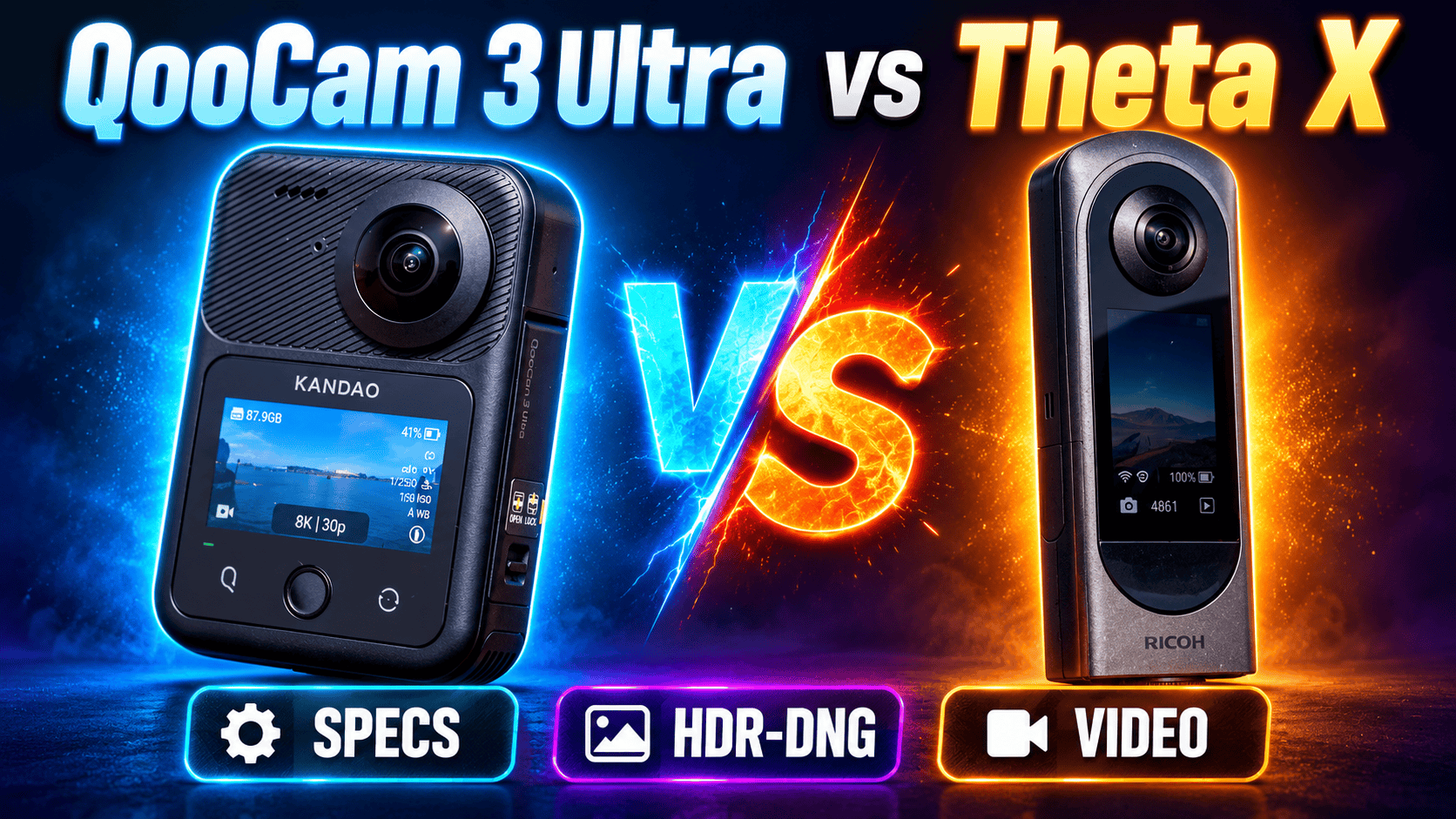
QooCam 3 Ultra vs Ricoh Theta X: Specs, HDR-DNG and Video
Technical comparison · Touchscreen cameras for tours and video
Both cameras offer touchscreen operation, removable batteries, internal storage and memory-card expansion. The Ultra adds 96 MP photos and 8K30 video; Theta X has a lighter body, 60 MP JPEG capture and an official HDR-DNG plug-in. Calling this simply “RAW versus JPEG” misses a supported Theta X workflow.
Which limitation are you trying to solve?
If a job requires 8K at normal motion-video frame rates, investigate Ultra: Theta X's documented 8K modes run at 10 or 2 fps, not 30 fps. If the main deliverable is a still tour, the choice is less direct. Compare the finished panorama and processing effort from the route you intend to use, including Theta X's HDR-DNG option where relevant.
For an operator already using Theta X successfully, Ultra's bigger files are a reason to request samples, not proof that every room will improve. For someone building a kit from scratch, both cameras address removable-power and storage needs; the remaining decision includes handling weight, software and how much video work accompanies the still photographs.
Photo, optics and exposure comparison
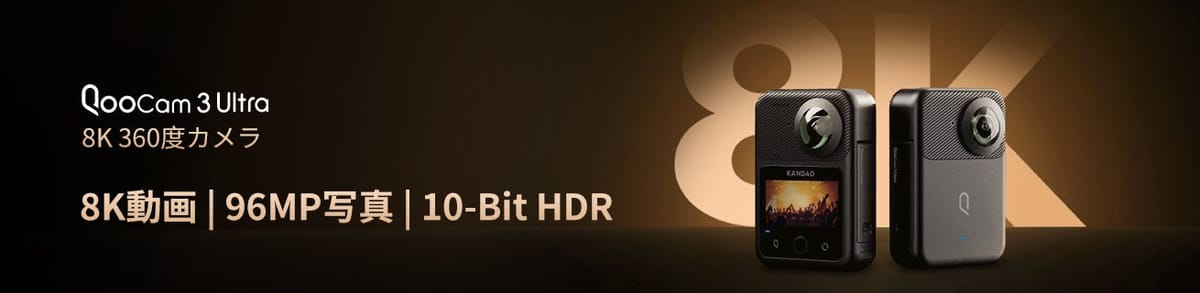
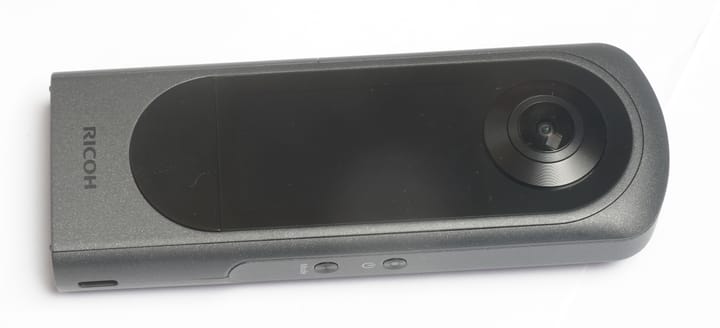
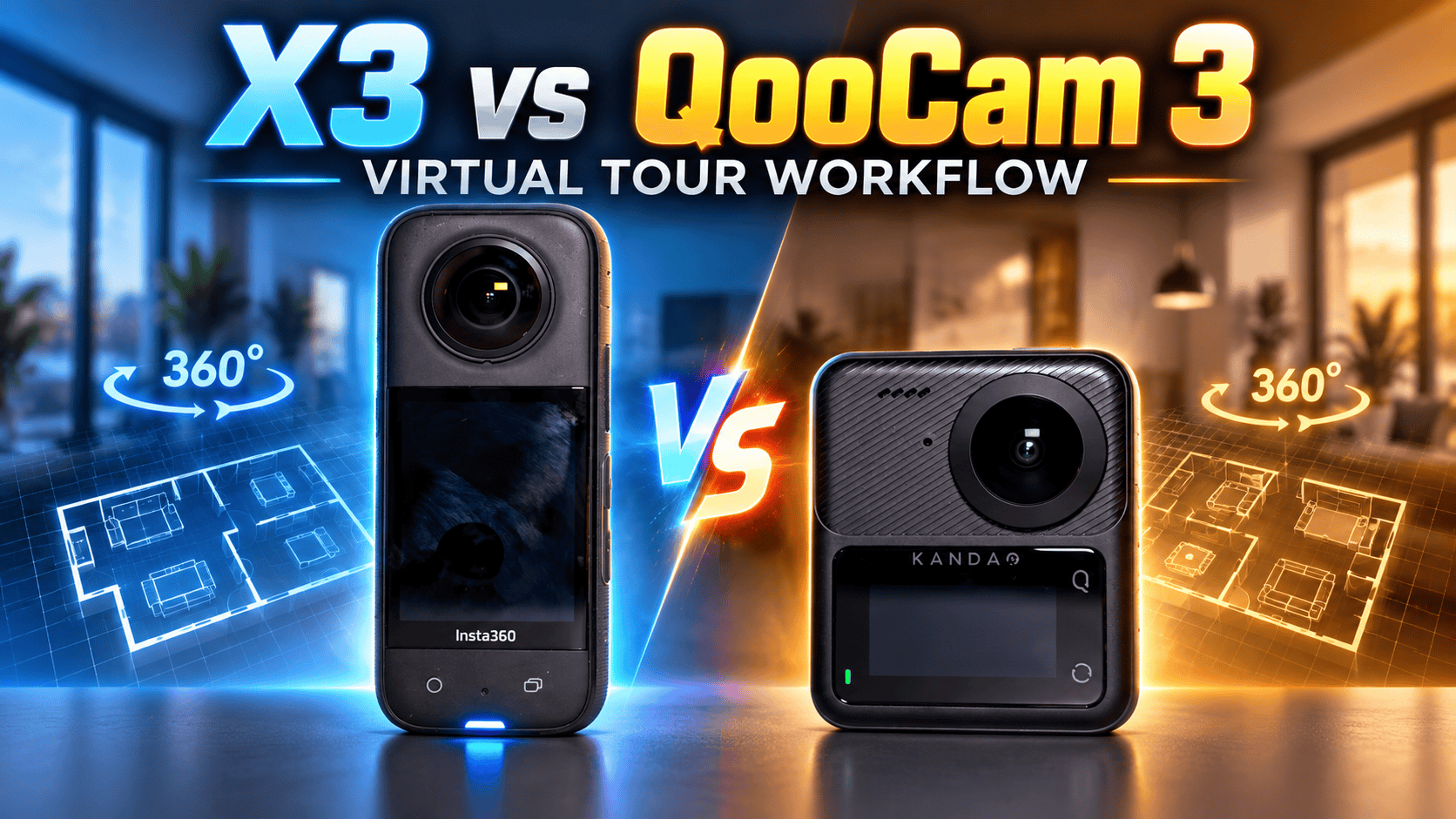
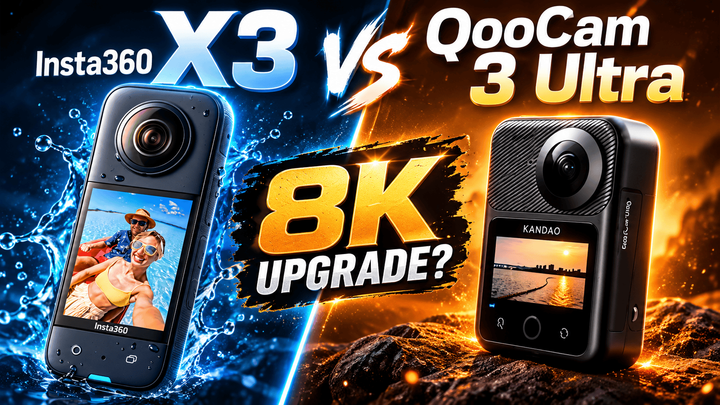
Product photographs are not to scale and are not sample images captured by either camera.
| Parameter | Ultra | Theta X |
|---|---|---|
| Sensor format | 1/1.7-inch type | Two 1/2-inch-type sensors |
| Aperture | f/1.6 | f/2.4 |
| Maximum panorama / JPEG | 13888 × 6944; 96 MP | 11008 × 5504; 60 MP |
| Lower-resolution photo | 6944 × 3472; 24 MP | 5504 × 2752; 15 MP |
| Image formats / RAW route | JPEG, DNG, EXR | Standard JPEG; separate official HDR-DNG plug-in |
| Ordinary ISO range | 100–6400 | 50–3200 |
| Manual photo shutter | 1/6400–50 s | 1/16000–60 s |
| Exposure compensation | ±4 EV | ±2 EV, 1/3-stop steps |
| Color temperature | Auto; 2500–10000 K | Auto, presets; 2500–10000 K |
Sources: Ultra technical specifications, Theta X manual and Theta X HDR-DNG documentation. An ISO ceiling or wider aperture does not quantify the difference in finished noise, sharpness or dynamic range.
Maximum listed panorama/JPEG width
Ultra — 13,888 pixels
Theta X — 11,008 pixels
Three workflows to test before choosing
Theta X standard JPEG: start with the camera's ordinary still route if fast delivery is the goal. Its listed functions include HDR rendering, handheld HDR, continuous capture, interval and multi-bracketing. A mode name alone does not prove how a difficult window will look after hosting.
Theta X HDR-DNG: Ricoh's official plug-in combines four RAW captures into a 16-bit HDR-DNG. The installation page specifies firmware 2.61.0 or later. Its workflow guide uses AP Wi-Fi, a tripod and a separate development/stitching route. It describes roughly ten seconds of processing after release, not a complete-job benchmark. Develop the DNG, export dual-fisheye JPEG or TIFF, then stitch and inspect the sphere.
Ultra multi-frame photography: the shooting guide describes DNG8 as eight same-exposure DNG captures merged in QooCam Studio. AEB varies exposure instead. The support FAQ limits DR Boost to 24 MP, ISO 6–100 and 1/800–30-second photo shutters. Do not compare that mode as if it produced the ordinary 96 MP output.
The practical test is a small set of quiet rooms with bright windows, dark surfaces and objects near seams. Record capture and editing time, then compare equally sized finished spheres. Camera JPEG, developed HDR-DNG and merged DNG8 are different production routes; a conclusion about one should not silently apply to the others.
Ricoh's September 2024 instructions distinguish feature availability from installation: HDR-DNG is described as available from firmware 2.60 and pre-installed from 2.61.0. Use the documented pre-installed route when preparing a camera. Stitcher accepts dual-fisheye JPEG or 8/16-bit RGB TIFF, not an arbitrary exported image format.
8K is not the same recording mode on both cameras
| Parameter | Ultra | Theta X |
|---|---|---|
| 8K | 24/25/30 fps | 7680 × 3840; 10 or 2 fps |
| 5.7K | 24/25/30/50/60 fps | 5760 × 2880; 30/10/2 fps |
| 4K | 100/120 fps in technical table | 3840 × 1920; 60/30 fps |
| 2K | Not listed in cited table | 1920 × 960; 30 fps |
| Maximum bitrate | 150 Mbps | 120 Mbps in selected modes |
| Codec / container | H.265 / MP4 | H.264 / MP4 |
| Color choices | 8-bit Rec.709; 10-bit HLG Pro, HLG Normal, K-Log | Comparable log/HLG choices not established in cited manual |
| Recorded audio | Four-channel AAC; 48 kHz, 16-bit | One-channel AAC-LC |
| Single-lens video | 4K up to 60 fps; 100 fps resolution disputed | Not listed in cited manual |
Ultra's technical table lists single-lens 4K100, but its FAQ says 3.4K100. Confirm the installed firmware and actual file before promising this output. A larger bitrate is not a measured image-quality score, and ten-bit recording needs suitable color management in the editing and delivery workflow.
Theta X's manual requires wireless LAN to be off for 8K10, 5.7K30, 5.7K10 and 4K60. Its specified alternative uses external power with the battery removed and the K-AC166 kit. Recording can stop when internal temperature rises. These restrictions matter to remote operation; they should not be hidden behind an 8K badge.
Field hardware and connectivity
| Parameter | Ultra | Theta X |
|---|---|---|
| Working weight | 336 g with battery | 170 g with battery and card |
| Width × height × depth | 71.5 × 103.2 × 26.6 mm | 51.7 × 136.2 × 29 mm |
| Touchscreen | 2.19 inches | 2.25 inches; 360 × 640 |
| Battery | Removable; 2280 mAh | Removable DB-110; 1350 mAh |
| Internal storage | 128 GB nominal; about 98.2 GB usable | About 46 GB |
| Memory card | microSD up to 1 TB; UHS-I V30; exFAT | microSDXC, 64 GB or larger; UHS-I V30; exFAT |
| USB | USB-C; USB 3.1 Gen 2 per FAQ | USB-C; USB 3.2 Gen 1 |
| Wi-Fi / Bluetooth | 2.4/5 GHz a/b/g/n/ac/ax; BLE 5.2 | 2.4/5 GHz a/b/g/n/ac, region-dependent; Bluetooth 5.0 |
| Location hardware | GPS | GPS, GLONASS, QZSS, SBAS; A-GPS support |
| Operating temperature | −20–40°C | 0–40°C |
| Water protection | IP68; 10 m manufacturer claim | No rating established by cited manual |
Do not derive matched endurance from battery capacity. Ultra quotes about 50 minutes for 10-bit 8K or 75 minutes for 8-bit 5.7K. Ricoh quotes about 250 still images, 30 minutes at 5.7K30 or 55 minutes at 4K30, using its method and firmware 1.20.0. None of these is a matched HDR-DNG interior workload.
Ultra's preparation guide quotes roughly 75 minutes for a full charge with a PD charger and the camera off; the FAQ specifies 9 V/2 A or 5 V/3 A. Its battery-removal advice during external power is inconsistent, so keep the battery installed and confirm your setup. Do not transfer Ricoh's battery-removed video instructions to the Ultra.
Software and transfer tests belong in the evaluation
Ricoh's 2024 HDR-DNG workflow identifies Lightroom Classic 13.5 in its instructions, not every later software version. It directs users to disable Auto Align in Lightroom HDR Merge. Test your installed developer and Stitcher combination with a small set before processing a whole building.
Ultra's support page lists Android 9 with Snapdragon 855 or Exynos 2200 and a 64-bit system, or iOS 13 with A12, as app baselines. Its Mac transfer instructions use MTP and require copying files locally before editing; removable cards offer a card-reader alternative. Published baselines are not assurances that all later app features work on every device.
Keep original captures, processed masters and delivery copies distinct. Internal camera storage is not a backup. Confirm that a full sphere survives the intended hosting path and inspect windows, seams and floor detail on phone and desktop before accepting a batch.
Choose for the actual assignment
Real estate: evaluate Theta X's quick JPEG and HDR-DNG routes separately against the intended Ultra mode. More editing steps may be worthwhile for one difficult room but unnecessary for another. Record the time cost rather than assuming that RAW is always faster or always better.
Construction: both have location hardware, but neither specification establishes survey accuracy or automatic model alignment. Maintain viewpoint IDs, camera height and consistent processing. Ultra's protection rating and Theta X's lighter working weight address different field concerns. See the construction-site virtual-tour workflow.
Travel: Ultra's 8K30 and slow-motion options matter when a destination shoot also needs promotional video. Theta X is the lighter listed kit. For owner-operated Panorra, preserve full-resolution destination spheres separately from social crops; no camera-specific integration test is claimed here.
Compare the complete production cost
Include compatible spare batteries, support, protection, software and processing time in current quotes. This page does not invent a sale price or benchmark score. Read the individual Ultra and Theta X guides, compare Theta X vs Z1, or return to the comparison directory.

Comments ()