Insta360 X3 vs QooCam 3: Specs and Virtual-Tour Workflows
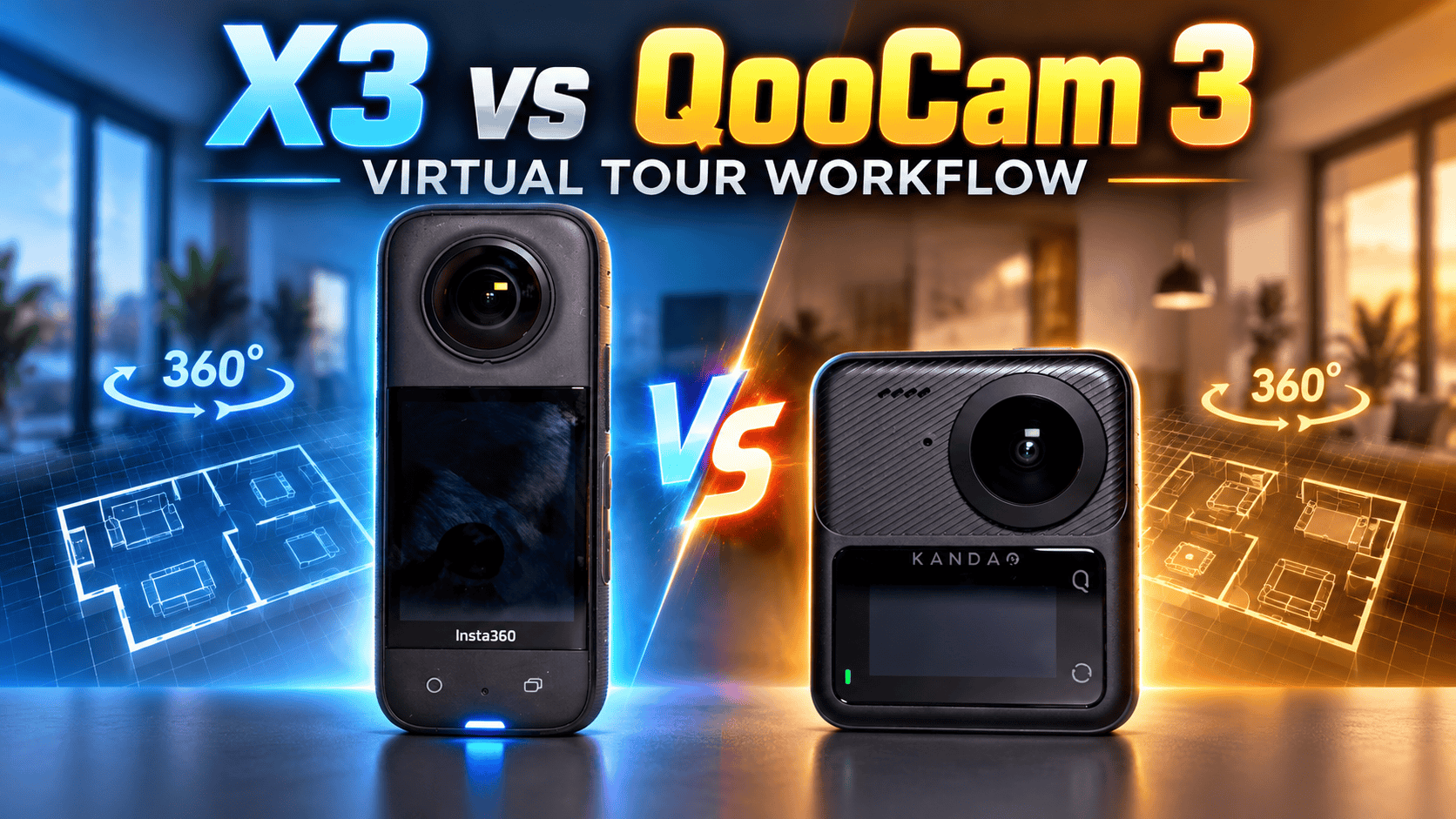
Technical head-to-head · Two card-based 5.7K systems
Both cameras offer ordinary 5.7K30 spherical video, removable batteries and card-based recording. X3 has a larger maximum still raster; QooCam 3 combines a different sensor format and aperture with DNG8 and AEB capture options. For a tour business, switching between them needs a workflow reason beyond their shared video headline.
Find the limitation before changing systems
Consider retaining X3 when its finished stills and clips already meet the brief. Moving to another 5.7K30 camera is not automatically a video-resolution upgrade. Compare the complete capture, editing and delivery route before replacing a working kit.
Consider QooCam 3 when you specifically want to evaluate its DNG8 or AEB route. A different aperture or sensor-format label does not prove better window recovery or lower noise in every room. Obtain originals, complete the processing and compare accepted panoramas at the same viewing size.
Neither camera's specification establishes a permanent price winner. Include software time, spare batteries, media, support and lens protection in current complete-kit quotes.
Sensors, exposure and panorama dimensions
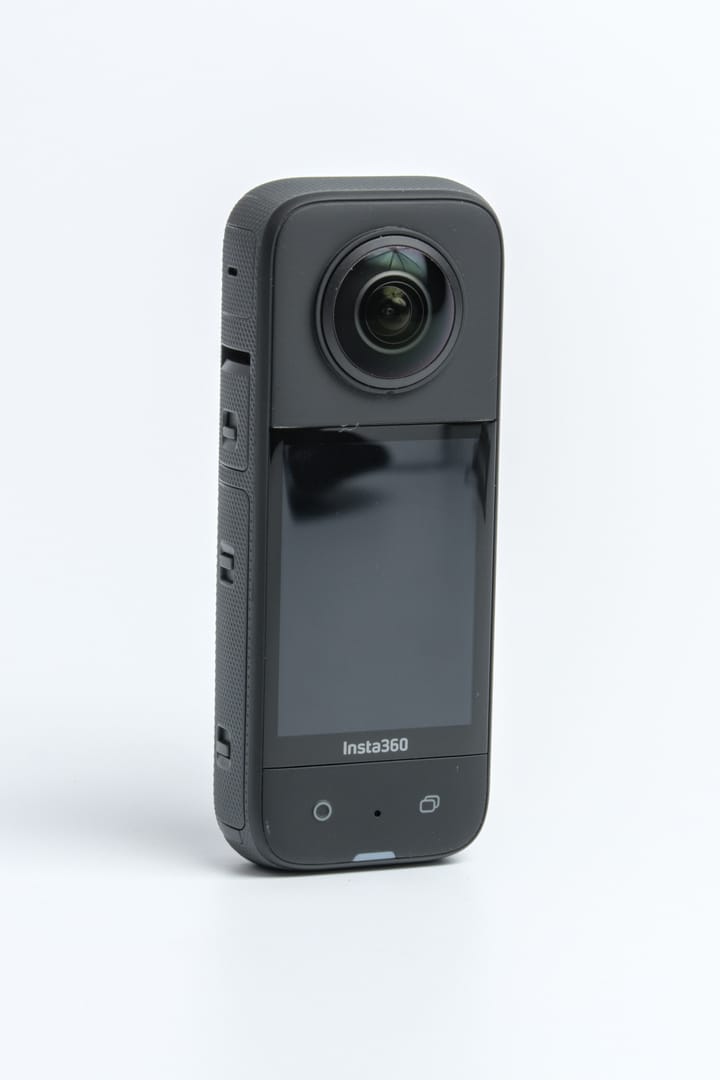
| Parameter | X3 | QooCam 3 |
|---|---|---|
| Sensor format | 1/2-inch type | 1/ |
| Aperture | f/1.9 | f/1.6 |
| Maximum panorama | 11968 × 5984; 72 MP | 11136 × 5568; 62 MP |
| Photo formats | INSP, DNG | JPG, DNG |
| ISO | 100–3200 | 100–6400 |
| Manual photo shutter | 1/ | 1/ |
| Exposure adjustment | ±4 EV | ±2 EV |
| White balance | 2000–10000 K | Auto; 2500–8000 K |
Sources: Insta360 shooting table, X3 column, shared hardware table and QooCam 3 specifications. Numeric exposure limits are not quality scores. In particular, the higher ISO ceiling does not establish a cleaner low-light result.
Maximum listed panorama width
X3 — 11,968 pixels
QooCam 3 — 11,136 pixels
Kandao's standard-model FAQ recommends a 1.5 m stitching distance. X3's listed 0.3 m minimum focusing distance measures something different; it does not promise clean stitching at that distance. Inspect nearby doorframes, furniture and railings crossing the seam before accepting a room capture.
HDR Photo, DNG8 and AEB need separate trials
| Route | Documented behavior | Check before a job |
|---|---|---|
| X3 HDR Photo | 18 MP in model-specific guide | Delivered detail and moving-object artifacts |
| X3 PureShot | Shared table directs processing to desktop Studio | Sample-original processing on the actual computer |
| QooCam DNG8 | Separate multi-frame RAW mode | Complete input set and working merge/export route |
| QooCam AEB | Exposure-bracket mode listed | Installed-firmware count, spacing and output format |
X3's parameter guide lists ordinary Photo at 72 or 18 MP, but HDR Photo, Burst and Starlapse at 18 MP. Do not combine its maximum photo size and HDR label into a fictional maximum-resolution HDR mode.
QooCam 3's technical table lists DNG8, AEB and TimeFusion separately. Its FAQ also says HDR photography is unsupported. That answer must not erase the separately listed exposure-bracket capability: capturing a bracket and delivering an automatically merged HDR sphere are different operations. This comparison does not establish a complete current count, exposure-step and format matrix.
A repeated-frame RAW workflow is not automatically an exposure bracket. Preserve all originals and document the selected mode so another editor can reproduce the result. Do not borrow Ultra's DR Boost, resolution or storage claims for the standard camera.
Kandao's September 2023 launch release describes processing eight DNG8 captures with Raw+. This establishes the intended multi-frame software route, not measured quality gains or compatibility with every current computer. Confirm working software access and complete a merge, development and stitched export before committing to a RAW-dependent job.
Use a fixed viewpoint in a room with bright windows, dark texture and a nearby seam-crossing object. Compare finished spheres at equal delivery size. Repeat with a moving curtain or person to expose multi-frame limitations, and measure total editing and cleanup time—not just shutter response.
Shared 5.7K30, different flat-video choices
| Parameter | X3 | QooCam 3 |
|---|---|---|
| 5.7K: 5760 × 2880 | 24/25/30 fps | 24/25/30 fps |
| 4K sphere | 24/25/30/50/60 fps in shared table | 24/25/30/50/60 fps |
| Lower ordinary mode | 3008 × 1504; 100 fps | Not listed in cited table |
| Container / codec | INSV / H.264 | MP4 / H.264 |
| Bitrate ceiling | 120 Mbps | 120 Mbps |
| Color styles | Standard, Vivid, LOG | Standard, ProColor |
| Single-lens ceiling | 4K30; lower modes up to 60 fps | 2880 × 2880 up to 60 fps |
Sources: manufacturer shooting/technical tables and QooCam FAQ above. X3's model-specific guide lists only 30/60 at 4K, while the shared table adds 24/25/50; verify the needed setting on the installed firmware. QooCam's exact spherical 4K raster is not established here, so its label is retained rather than inferred.
Equal bitrate ceilings and shared codecs do not establish identical detail, stabilization or compression artifacts. A sphere also distributes its pixels around the entire scene; a forward crop does not retain the full spherical resolution. Compare the final framing on the actual viewing device.
QooCam's FAQ describes five-minute file segmentation during continuous recording. That is not a five-minute total-session limit. It also excludes external microphones and live streaming. Check the speech-capture and offload plan separately if the assignment includes interviews or a remote site meeting.
Special modes should not inflate ordinary recording claims
X3's parameter guide lists Active HDR at 5.7K24/25/30, Bullet Time at 4K120 or 3K180, and timelapse playback at 8K or 5.7K24/25/30. None of those entries makes it an ordinary 8K camera or extends its ordinary-video frame-rate table.
X3's default single-lens video applies FlowState in camera; its FOV+ route uses app or Studio processing for stabilization, horizon lock and aspect ratio. QooCam's FAQ describes stabilization through its app or QooCam Studio. Neither processing route is evidence of a measured walking-stabilization win.
For a construction record, preserve dated individual panoramas separately from a promotional timelapse. A finished accelerated clip cannot replace an accessible viewpoint record when someone needs to inspect a particular visit.
Card limits and battery scope matter in the field
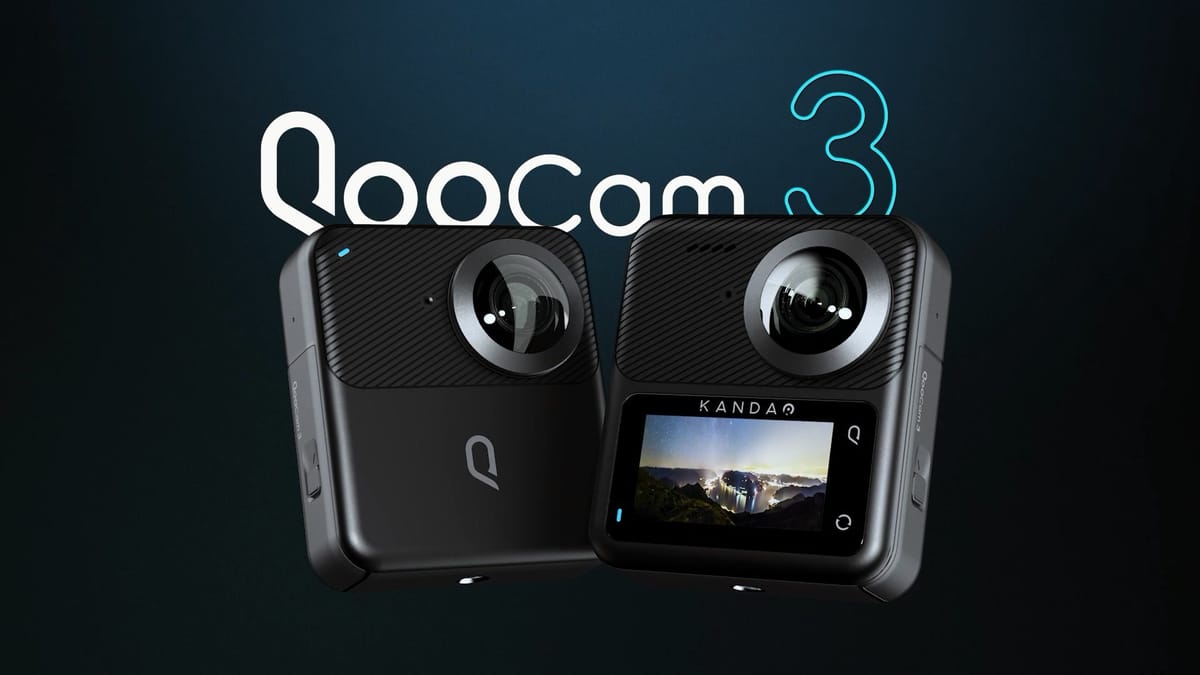
| Parameter | X3 | QooCam 3 |
|---|---|---|
| Published weight | 180 g | 189 g without battery |
| W × H × D | 46 × 114 × 33.1 mm | 71.5 × 82.7 × 26.6 mm |
| Touchscreen | 2.29-inch; 344 × 476 | 1.9-inch |
| Removable battery | 1800 mAh | 1600 mAh |
| Internal recording storage | None listed | None |
| Card requirement | microSD UHS-I V30 or faster | microSD UHS-I V30 or faster; ≤256 GB, exFAT |
| USB | Type-C 2.0 | Type-C; generation unverified |
| Bluetooth | 5.0 | 4.2 |
| Operating range | −20–40°C | −20–40°C |
| Protection | 10 m body-depth claim | IP68 |
Sources: shared X3 hardware table and standard QooCam specifications. QooCam's 256 GB card limit and lack of internal recording memory differ from Ultra; do not order media from the wrong model's specification. A card reader offers an offload route, not an automatic backup.
The QooCam launch release gives a different 201 g figure without the same explicit battery scope. The table follows the current technical page's labelled 189 g body-only figure. We have not established a verified working-weight measurement, so neither number is used to calculate an X3 carrying-weight advantage.
X3's hardware manual quotes around 81 minutes at 5.7K30 under its specified laboratory settings. QooCam quotes around 58 minutes under its own conditions. These are not matched endurance tests or guaranteed still-tour workloads. Test remote connection, screen use, processing and transfer as part of a full working session.
Water protection does not promise clean underwater stitching or universal resistance to site hazards. Keep ports and covers correctly secured and protect both exposed lenses. Inspect used batteries and optics before deploying a second-hand kit commercially.
Test the software and the delivered job together
Kandao's support page lists standard-camera firmware 1.4.0.2 dated 12 June 2026, with connection, timelapse and card-handling changes. That is a documented release listing, not a claim that we installed or tested it. Confirm the installed version and rehearse a short capture/export job before a paid assignment.
Property: compare the actual X3 HDR/PureShot and QooCam DNG8/AEB routes through a finished room. Keep originals, processing masters and delivery copies separately. A DNG file is not automatically a hosted panorama.
Construction: both systems need card and spare-power planning. Use fixed viewpoint IDs, consistent height, dates and processing notes; neither is presented as survey-grade equipment. See the construction-site virtual-tour workflow.
Travel: decide whether the trip needs navigable spheres, immersive video or flat promotional clips. For owner-operated Panorra, retain full-sphere masters independently of crops. Test offload and editing on the device you will actually carry.
GoThru operates this publication. No camera-specific end-to-end hosting test is claimed here. Inspect orientation, seams, image loading and navigation on phone and desktop after a pilot upload.
Read the individual X3 and QooCam 3 guides, compare QooCam 3 vs Ultra or X3 vs Ultra, and explore the comparison selector.

Comments ()