Insta360 X3 vs Ricoh Theta X: Specs and Tour Workflows
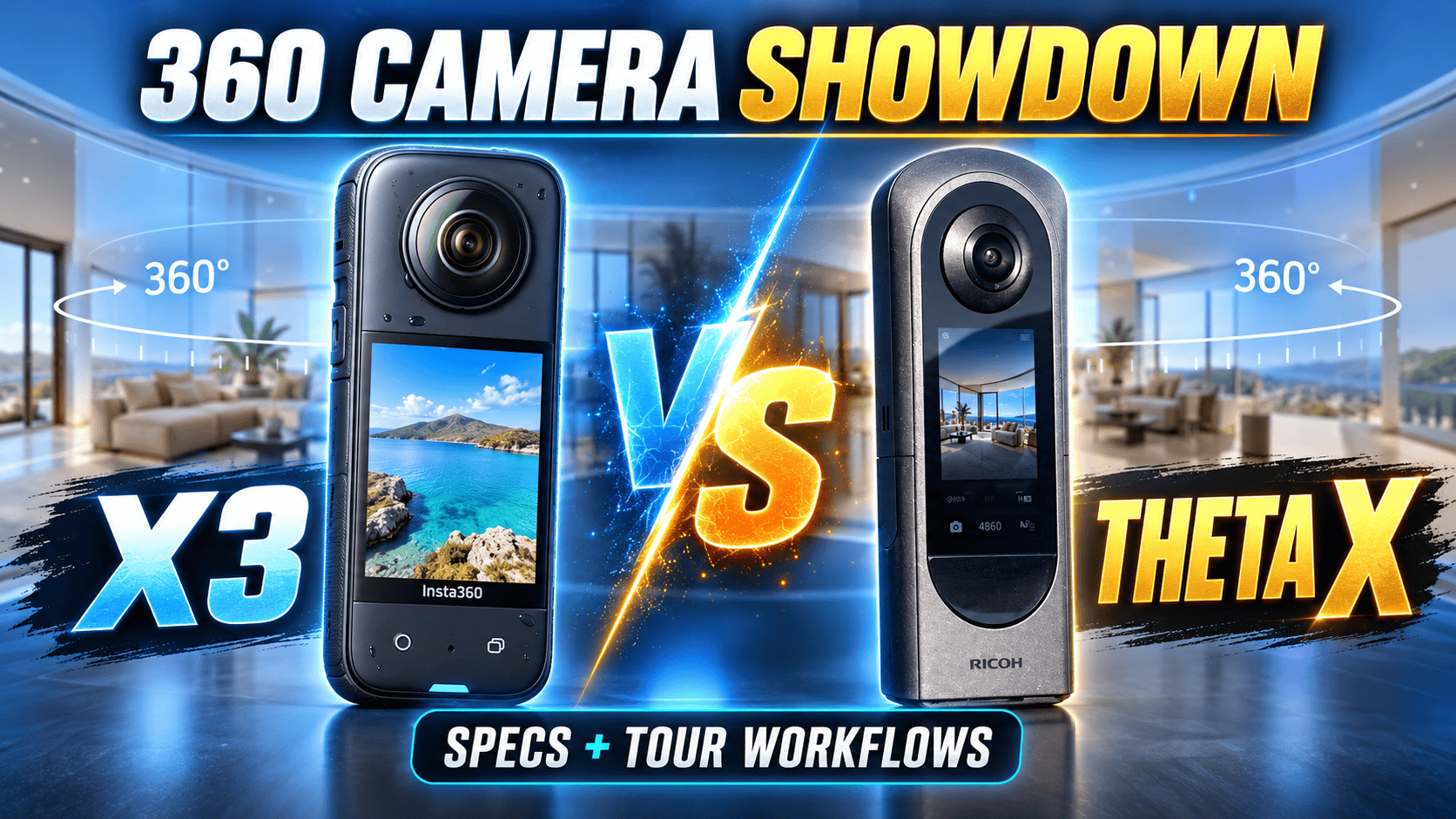
Technical comparison · Two 2022 cameras, different production workflows
X3 and Theta X both combine touchscreens, removable batteries and 1/2-inch sensor formats with 5.7K30 spherical recording. The more useful distinction is how they capture, process and deliver a job: X3 adds action-oriented video options, while Theta X offers internal storage, location hardware and a separate HDR-DNG still workflow.
Which camera fits the work you already do?
Shortlist X3 when still panoramas and motion content share one kit. Its single-lens, Active HDR and special slow-motion modes add delivery options beyond a conventional virtual tour. That does not prove that its largest photo produces the best finished interior.
Shortlist Theta X when repeatable still-tour capture is the priority. Internal storage and location hardware may simplify field logistics; ordinary JPEG and HDR-DNG require different production plans. Unlike a comparison with Theta Z1, both cameras here have removable batteries and live-view touchscreens.
Owners of either camera should identify a specific missing deliverable before buying the other. Shared 5.7K30 and 4K60 mode labels are not, on their own, a compelling replacement argument. Include newer models in the comparison directory when evaluating current complete-kit quotes.
Sensors, exposure controls and panorama sizes
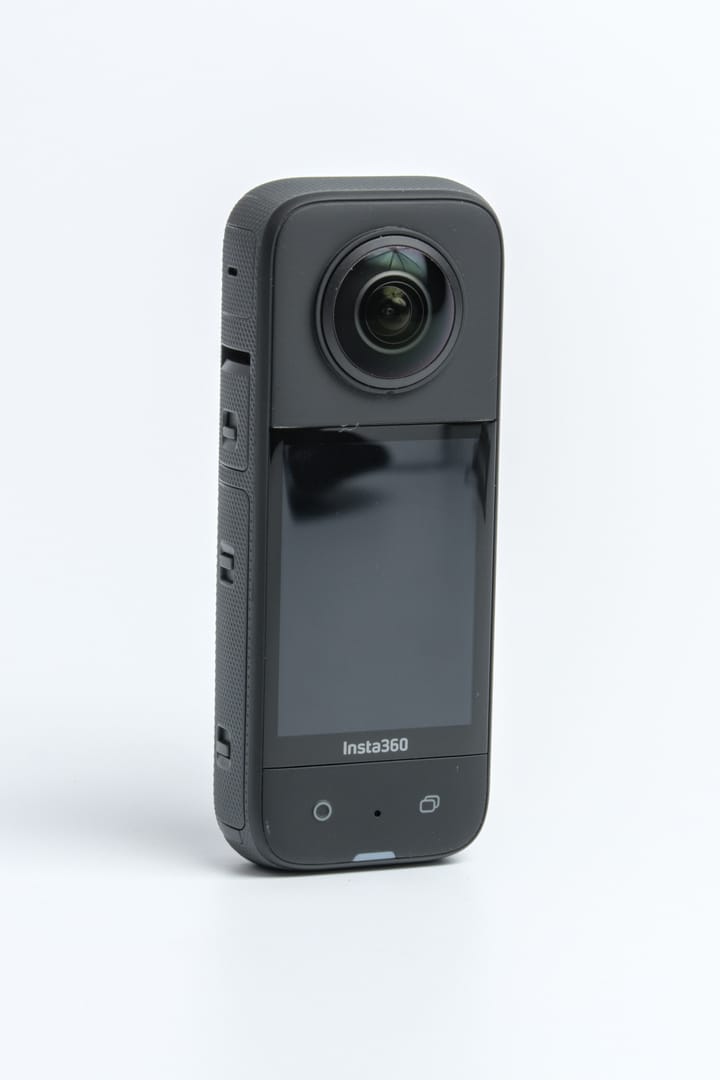
| Parameter | X3 | Theta X |
|---|---|---|
| Sensor format | Dual 1/2-inch type | Dual 1/2-inch type |
| Aperture | f/1.9 | f/2.4 |
| Largest panorama | 11968 × 5984; 72 MP | 11008 × 5504; 60 MP |
| Smaller panorama | 5952 × 2976; 18 MP | 5504 × 2752; 15 MP |
| Still formats | INSP, DNG | Ordinary JPEG; separate HDR-DNG plug-in |
| ISO range | 100–3200 | 50–3200 |
| Manual photo shutter | 1/ | 1/ |
| Exposure compensation | ±4 EV | ±2 EV; one-third-stop steps |
| Color temperature | 2000–10000 K | 2500–10000 K |
| Minimum focus | 0.3 m | Approximately 0.4 m |
Sources: Insta360 hardware table, X3 column, shared shooting specifications and Theta X manual. The shared sensor-format label does not establish identical sensors or processing. Minimum focusing distance is not a stitching-clearance guarantee.
Largest listed panorama width
X3 — 11,968 pixels
Theta X — 11,008 pixels
HDR workflows need their own comparison
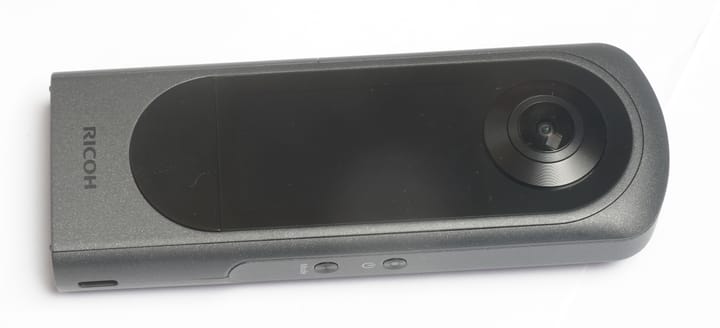
| Route | Capture | Processing consideration |
|---|---|---|
| X3 ordinary photo | 72 or 18 MP | Check selected format and export settings |
| X3 HDR Photo | 18 MP in model-specific manual | Bracket count and exposure-step matrix not established here |
| X3 PureShot | RAW processing route | Shared specifications direct processing to desktop Studio |
| Theta X ordinary still | JPEG; HDR rendering and handheld HDR listed | Inspect the processed sphere |
| Theta X HDR-DNG | Four RAW exposures combined into HDR-DNG | Develop dual-fisheye output, then stitch |
X3's parameter manual limits HDR Photo, Burst and Starlapse to 18 MP. Do not turn “72 MP, DNG, HDR” into a promise that every combination is available. Its ordinary INSP export route should not be confused with the desktop requirement documented for PureShot processing.
Ricoh's HDR-DNG plug-in adds a RAW-derived route beyond Theta X's ordinary JPEG specification; installation requires firmware 2.61.0 or later. Its processing guide describes 16-bit output, RAW development into dual-fisheye JPEG or RGB TIFF and subsequent THETA Stitcher processing. This is not a one-step substitute for every JPEG job.
For real-estate work, compare finished room spheres at the same viewing size. Include bright windows, dark textures, close furniture and a moving curtain. Time capture, development, seam inspection and delivery separately. The maximum-width chart cannot determine either camera's useful dynamic range or the faster complete HDR workflow.
Theta X's separate Multi Bracket mode accepts 2–13 sets of shutter speed, ISO and white balance. This configurable sequence is not the same operation as its four-exposure HDR-DNG plug-in. X3's bracket count and exposure steps remain unestablished here; do not import another model's AEB limits into a job specification.
Shared headline modes do not make identical video tools
| Parameter | X3 | Theta X |
|---|---|---|
| 8K: 7680 × 3840 | Not ordinary video | 2/10 fps |
| 5.7K: 5760 × 2880 | 24/25/30 fps | 2/10/30 fps |
| 4K: 3840 × 1920 | 24, 25, 30, 50, 60 fps | 30/60 fps |
| Other ordinary modes | 3008 × 1504 at 100 fps | 1920 × 960 at 30 fps |
| Original container | INSV for 360; MP4 for single-lens | MP4 |
| Codec | H.264 | H.264 |
| Maximum bitrate | 120 Mbps | 120 Mbps in selected modes |
| Color profiles | Standard, Vivid, LOG | Equivalent log option not established |
| Audio | 48 kHz, 16-bit AAC; stereo, wind reduction, Direction Focus | Mono AAC-LC |
The shared Insta360 shooting table supplies the broader X3 4K frame-rate list; its model-specific parameter page lists only 30/60 there. Check the camera firmware and intended frame rate before a job. Theta X's low-frame-rate 8K is not conventional 8K30 motion recording, and X3's 8K timelapse is not ordinary 8K video.
Both cameras can record 5.7K30 or 4K60, but that does not establish identical stabilization, detail or heat tolerance. A reframed forward view uses only part of the sphere. Matching codec and maximum bitrate labels also do not establish a matched image-quality result.
Theta X's recording FAQ reports heat-limited operation of approximately ten minutes at 5.7K30/4K60 at 25°C, potentially less in other conditions. It excludes smartphone transfer of 5.7K30 and makes 4K60 transfer device-dependent. Plan card-reader or computer offload where required.
Theta X's selectable recording bitrates, in Mbps, are 120/96/40 for 8K10; 64/32/16 for 8K2; 120/64/32 for 5.7K30; 80/60/40 for 5.7K10; 16/12/8 for 5.7K2; 120/64/32 for 4K60; 100/54/32 for 4K30; and 32/16/8 for 2K30. Its separate USB streaming specification is 4K30 at 100 Mbps or 2K30 at 32 Mbps, with mono linear PCM audio. These streaming numbers do not describe recorded MP4 files.
Ricoh requires Wi-Fi to be off for 8K10, 5.7K30, 5.7K10 and 4K60 recording unless the battery is removed and the specified K-AC166 external-power setup is used. Check both the intended recording mode and control method before mounting a camera somewhere difficult to reach.
Action clips versus deliberate time sequences
X3's parameter manual lists Active HDR and TimeShift at 5.7K24/25/30, Bullet Time at 4K120 or 3K180, and timelapse playback at 8K or 5.7K24/25/30. Those special-mode rates do not extend its ordinary-video table. Timelapse capture intervals run from 0.2 to 120 seconds in the listed steps; the manual does not give a complete resolution-by-interval matrix.
Single-lens X3 video lists 3840 × 2160 at 24/25/30 fps; 3584 × 2016, 2720 × 1530 and 1920 × 1088 add 50/60. Default-field-of-view video applies FlowState in camera, while FOV+ uses app or Studio processing for stabilization, horizon lock and aspect ratio. The model-specific guide lists Me Mode at 1080p30/60, despite the shared table's contradictory unsupported entry. No PureVideo or InstaFrame support is established for X3.
X3 interval stills offer 72 or 18 MP and 3/5/10/30/60/120-second spacing. For a construction record, keep individual dated panoramas independently of a promotional timelapse. Similarly named Theta X Time Shift and Insta360 TimeShift are not interchangeable workflows: Ricoh's still function exposes the two lenses sequentially rather than making an accelerated-motion clip.
Theta X's interval mode spans 6 seconds–60 minutes in one-second steps, with 2–200 shots or an unspecified count and either 11008 × 5504 or 5504 × 2752 output. Its Time Shift controls offer first-lens settings of 0–10 seconds and second-lens settings of 1–10 seconds. Moving subjects can change between the sequential exposures.
X3's timelapse interval choices are 0.2, 0.5, 1, 2, 4, 10, 30, 60 and 120 seconds. Loop recording offers 1/3/5/10/15/20/25/30-minute durations. Its shooting FAQ limits 15/30-second pre-recording to ordinary 360 and single-lens Video modes, rather than every special mode, and excludes HDMI output. Keep playback frame rate, capture interval and retained loop duration distinct.
Storage and power can decide a field assignment
| Parameter | X3 | Theta X |
|---|---|---|
| Weight | 180 g | 170 g with battery/card; 144 g body-only |
| W × H × D | 46 × 114 × 33.1 mm | 51.7 × 136.2 × 29 mm |
| Touchscreen | 2.29-inch LCD; 344 × 476 | 2.25-inch LCD; 360 × 640 |
| Removable battery | 1800 mAh | DB-110; 1350 mAh |
| Recording storage | microSD up to 1 TB; UHS-I V30, exFAT | About 46 GB internal; microSDXC ≥64 GB, UHS-I V30, exFAT |
| USB | Type-C 2.0 | Type-C 3.2 Gen 1 |
| Bluetooth | 5.0 | 5.0 |
| Wi-Fi | 2.4/5 GHz; 802.11a/b/g/n/ac | 802.11a/b/g/n/ac; available bands depend on region |
| Operating temperature | −20–40°C | 0–40°C |
| Body water rating | 10 m manufacturer claim | Equivalent rating not established |
| Location hardware | Built-in GNSS not established here | GPS/GLONASS/QZSS/SBAS; A-GPS |
The shared hardware manual quotes X3 runtime of 81 minutes at 5.7K30 with High bitrate, screen off and Wi-Fi Auto at 25°C. Ricoh quotes approximately 250 stills, 30 minutes at 5.7K30 or 55 minutes at 4K30 under its own method. These are not matched virtual-tour workloads; battery capacity cannot be converted into a percentage rooms-per-charge advantage.
X3's product specifications quote approximately 90 minutes for charging at 5 V/3 A. The shared hardware manual qualifies its charge figure with camera-off, 25°C laboratory conditions. Ricoh's endurance values use firmware 1.20.0 and its own measurement method. Measure a representative full session, including screen use, processing and transfers, rather than treating either laboratory value as a job guarantee.
Theta X's internal storage can keep a shoot moving without a card, but it is not an independent backup. X3's body water rating does not guarantee clean underwater stitching; evaluate the appropriate dive case for that work. Protect both cameras' protruding optics during transport and inspect used equipment before relying on it commercially.
Compare complete exports, not only capture settings
X3's product compatibility list starts at A11/iOS 13, or Android examples including Snapdragon 845, Kirin 980, Exynos 9810 and Tensor Pixel 6. App installation requires a 64-bit system; SDM765 5G is excluded. Snap Wizard has a separate, higher Android/iPad requirement. The page supports wireless iOS/Android use but explicitly excludes wired iOS connection. Check the current app version and a representative export, not just whether the phone can pair.
X3 lists a six-axis gyroscope, FlowState and 360° Horizon Lock; these features are not evidence of a matched stabilization win. Its optional microphone adapter provides a 3.5 mm input route, and Sticky Lens Guards protect rather than replace the optics. Theta X lists TR-1 remote-release compatibility. Exact mounting-thread and accessory-clearance requirements are not established here: confirm the specific pole, support and power access before deployment.
Run representative X3 originals through the actual Insta360 app or Studio installation you will use. For Theta X, test ordinary JPEG separately from HDR-DNG development and stitching. A successful phone connection does not prove acceptable transfer speed, high-resolution editing performance or support for every recording mode.
Retain capture originals, processing masters and final hosted panoramas as separate assets. Test the finished equirectangular export on the target platform and inspect seams, orientation and image loading. No camera-specific GoThru or Panorra certification is inferred from a file-format specification.
Real estate, construction and travel recommendations
Real estate: shortlist Theta X when internal storage and its documented HDR-DNG pipeline solve an existing workflow problem. Keep X3 in consideration when property photos and motion clips share the same operator and kit. Compare X3's actual 18 MP HDR route with the selected Theta X route rather than contrasting unrelated maximum pixel counts.
Construction: Theta X's location hardware and X3's action-oriented capture/protection address different requirements. Neither is presented as survey-grade equipment. Use repeatable viewpoint IDs and processing settings; if switching cameras mid-project, make an overlapping reference visit. See the construction-site virtual-tour workflow.
Travel: X3's flat and special video modes are useful when one trip needs multiple media formats; Theta X remains relevant to deliberate destination panoramas. Preserve the immersive master separately from social crops for owner-operated Panorra. Decide from the required outputs and complete transport/editing kit, not an assumed permanent price winner.
Read the X3 and Theta X guides, consider X4 vs Theta X or Theta X vs Z1, and browse the comparison directory.


Comments ()