GoPro MAX2 vs Ricoh Theta X: Specs and HDR Workflows
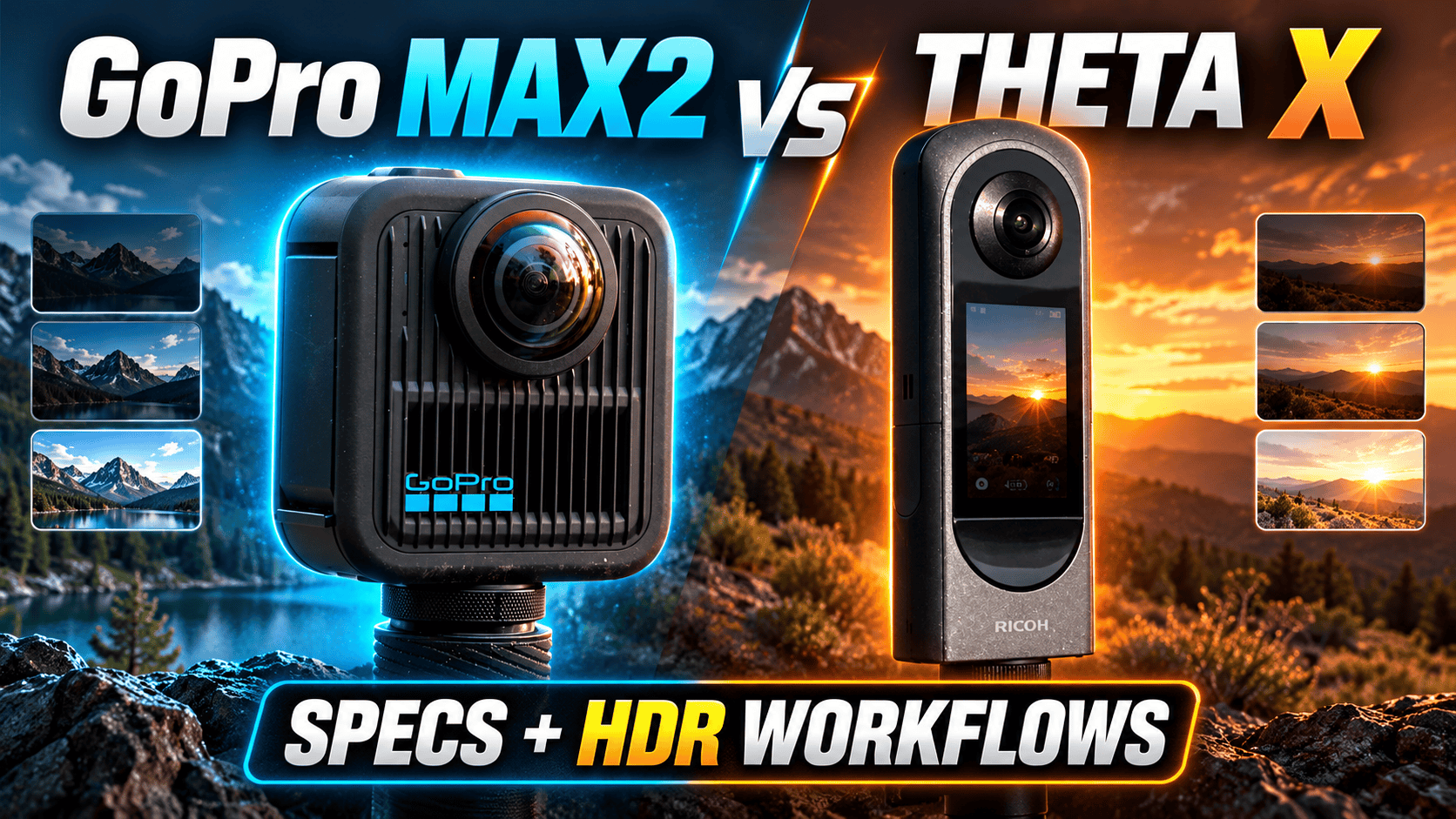
Technical comparison · Action recording and deliberate still-tour capture
MAX2 prioritizes action-oriented video, replaceable lenses and reframing. Theta X combines larger standard still panoramas, internal storage and a separate HDR-DNG option. Both have removable batteries, touchscreens and location hardware, so the useful distinctions go beyond a simple feature checklist.
Choose around the job, not an overall score
Shortlist MAX2 for a video-led assignment. Its conventional 8K30 recording and high-frame-rate lower-resolution modes offer a different motion toolset from Theta X's low-frame-rate 8K. Replaceable lenses can also change the recovery plan after field damage. These are documented capabilities, not evidence of a universal picture-quality win.
Shortlist Theta X for a deliberate still-tour process. Its internal storage and optional HDR-DNG production route may matter more than action modes. Ordinary JPEG, custom bracketing and HDR-DNG are different capture methods; choose the one the team can reliably deliver.
For an existing owner, identify a missing deliverable before replacing equipment. Adding MAX2 for motion footage need not displace a working Theta X interior workflow, and adopting Theta X for stills need not replace MAX2 for travel video.
Photo specifications and exposure controls
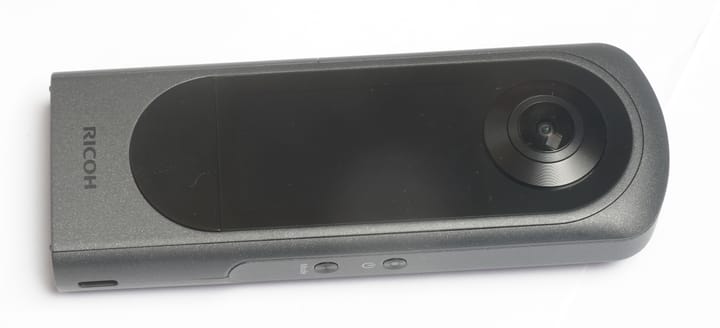
| Parameter | MAX2 | Theta X |
|---|---|---|
| Sensor format | Dual 1/ | Dual 1/2-inch type |
| Aperture | f/1.8 | f/2.4 |
| Standard panorama | 7680 × 3840; approximately 29.5 MP | 11008 × 5504; 60 MP |
| Other photo sizes | Single-lens: 4000 × 3000 | Smaller sphere: 5504 × 2752; 15 MP |
| Still formats | .36P/JPG sphere; GPR RAW single-lens only | Ordinary JPEG; separate HDR-DNG plug-in |
| ISO | Photo 100–3200; Night 100–800 | 50–3200 |
| Photo shutter | Auto or 1/ | Manual: 1/ |
| Exposure compensation | ±2 EV | ±2 EV; one-third-stop steps |
| Color temperature | 2300–6500 K | 2500–10000 K |
| Minimum focus | Equivalent numeric value not established | Approximately 0.4 m |
Sources: MAX2 technical panel, MAX2 manual and Theta X specifications. Sensor-format labels are not noise or dynamic-range scores. Minimum focus is not a guarantee of a clean seam around nearby objects.
Standard panorama width
MAX2 — 7,680 pixels
Theta X — 11,008 pixels
Labs JPEG brackets and HDR-DNG are different workflows
MAX2's spherical photo formats are .36P and JPG. Its GPR RAW option applies to single-lens photography; it must not be advertised as native spherical RAW. The optional Labs bracket preset instead uses JPG for MAX2 spheres and offers up to nine selected exposure positions from −4 to +4 EV.
The Labs preset triggers from the physical shutter or compatible BLE remote, not Quik. Optional file renaming hides the results from camera and Quik playback, and the preset keeps the camera on until the user changes mode or powers it off. These restrictions affect a multi-room production plan.
The separate Labs HDRI tool merges JPEG exposures into a lighting-environment .HDR file. Its introduction specifies up to eleven two-stop exposures, while later timing text still refers to nine. Verify the chosen script rather than promising one fixed capture duration. A lighting HDRI is not automatically a ready-to-host tone-mapped tour panorama.
Theta X's official HDR-DNG plug-in combines four RAW captures into a RAW-derived HDR file, separately from ordinary JPEG capture. Installation requires firmware 2.61.0 or later. Ricoh's workflow guide describes 16-bit output, development to dual-fisheye JPEG or RGB TIFF, then THETA Stitcher processing.
Do not label either camera simply “HDR capable” and stop there. Compare accepted room panoramas, seam cleanup and total operator time. Include bright windows, dark textures and moving objects in a representative test; multiple exposures can introduce motion differences that a resolution table cannot predict.
8K and 4K labels hide important differences
| Parameter | MAX2 | Theta X |
|---|---|---|
| 8K: 7680 × 3840 | 24/25/30 fps | 2/10 fps |
| Intermediate modes | 5376 × 2688 at 25, 30, 50, 60 fps | 5760 × 2880 at 2/10/30 fps |
| Mode labelled 4K | 3328 × 1664 at 50, 60, 90, 100 fps | 3840 × 1920 at 30/60 fps |
| 2K: 1920 × 960 | Not listed as ordinary spherical video | 30 fps |
| Container / codec | .360 / HEVC | MP4 / H.264 |
| Bitrate | Launch panel: 120 Mbps; June update: up to 200 Mbps in specified modes | Up to 120 Mbps in selected modes |
| Log / color | GP-Log; mode-specific 10-bit support | Equivalent log/10-bit option not established |
| Audio | Six microphones; stereo/360 audio; WAV single-lens only | Mono AAC-LC |
The 25 June 2026 GoPro announcement assigns up to 200 Mbps to 8K spherical and 4K single-lens recording. The technical panel still lists 120 Mbps. Keep firmware-specific figures distinct from optional Labs bitrate claims and record the mode used for any future test.
MAX2's mode called 4K uses fewer pixels than Theta X's 3840 × 1920 mode, while offering higher frame rates. Conversely, MAX2's 8K30 is a conventional-motion option rather than Theta X's 8K10/2. Neither product name nor nominal resolution should substitute for exact dimensions and intended playback.
Theta X's video FAQ describes roughly ten minutes at 5.7K30/4K60 at 25°C before heat limits, potentially less in other conditions. It excludes 5.7K30 smartphone transfer and makes 4K60 transfer device-dependent. A stated per-recording setting is not an uninterrupted-runtime guarantee.
Theta X's recording bitrates, in Mbps, are 120/96/40 at 8K10; 64/32/16 at 8K2; 120/64/32 at 5.7K30; 80/60/40 at 5.7K10; 16/12/8 at 5.7K2; 120/64/32 at 4K60; 100/54/32 at 4K30; and 32/16/8 at 2K30. Its separate USB streaming modes are 4K30 at 100 Mbps and 2K30 at 32 Mbps, with mono linear PCM audio rather than the recorded-file audio format.
Ricoh requires Wi-Fi off for 8K10, 5.7K30, 5.7K10 and 4K60 unless using the specified K-AC166 external-power arrangement with the battery removed. Check the intended mode and control method before placing the camera somewhere difficult to access.
Special modes are not interchangeable with still records
| Parameter | MAX2 | Theta X |
|---|---|---|
| Single-lens video | 4K at 24, 25, 30, 50, 60 fps; 1080p at 50/60 | Equivalent mode not listed |
| POV / Selfie | Retains full sphere and ordinary spherical recording options | Equivalent mode not listed |
| TimeWarp | Sphere 8K30 or 5.6K30; flat 4K30 or 1080p30 | Not an equivalent moving-timelapse mode |
| Time Lapse / Night Lapse | Sphere 8K30 or 5.6K30 | Interval stills |
| Exposure sequence | Optional Labs JPEG brackets | Multi Bracket or separate HDR-DNG |
| Time Shift still | Equivalent sequential-lens mode not established | Sequential lenses allow operator movement |
The June firmware announcement adds 10-bit and GP-Log across TimeWarp, Night Effects, Time Lapse and Night Lapse. This extends launch-era video guidance; it does not add spherical RAW photo support. Keep the video color pipeline separate from still capture format.
MAX2's single-lens 4K dimensions are 3840 × 2160, 2160 × 3840 or 4000 × 3000; 1080p is 1920 × 1080 or 1080 × 1920. Its POV and Selfie modes retain the full sphere for later reframing rather than recording only the displayed viewpoint. Max HyperSmooth and horizon lock are documented features, not a matched stabilization win.
Theta X's Multi Bracket supports 2–13 custom sets of shutter, ISO and white balance. Its interval still mode spans six seconds–60 minutes in one-second steps, with 2–200 shots or an unspecified count. These controls serve different needs from an automatically accelerated video.
Theta X's Time Shift controls allow first-lens settings of 0–10 seconds and second-lens settings of 1–10 seconds in one-second steps. The lenses expose sequentially, so moving subjects can change between the two halves. Interval capture separately offers 11008 × 5504 or 5504 × 2752 output.
MAX2's 29 MP burst choices are 5 or 10 frames in one second, 10 or 30 in three seconds, or 30 in six seconds. Its Star Trails, Light Painting and Vehicle Lights modes output 8K30 or 5.6K30 spherical video. The manual lists TimeWarp speeds from 2× to 30× or Auto, plus scheduled capture up to 24 hours ahead. A complete MAX2 interval-by-resolution matrix is not established here; check the selected camera preset before planning a long unattended sequence.
For construction, retain dated and navigable still panoramas independently of promotional time sequences. A moving timelapse can show activity without preserving the inspection record a client needs.
Field maintenance, power and storage
| Parameter | MAX2 | Theta X |
|---|---|---|
| Weight | 195 g with battery and mounting fingers | 170 g with battery/card; 144 g body-only |
| W × H × D | 64 × 69.7 × 48.7 mm | 51.7 × 136.2 × 29 mm |
| Touchscreen | 1.82-inch LCD | 2.25-inch LCD; 360 × 640 |
| Removable battery | 1960 mAh Enduro | DB-110; 1350 mAh |
| Storage | microSD A2 V30 or better; maximum capacity not established here | Approximately 46 GB internal; microSDXC ≥64 GB, UHS-I V30, exFAT |
| USB | Type-C 3.0 | Type-C 3.2 Gen 1 |
| Bluetooth | BLE 5.3 | 5.0 |
| Listed Wi-Fi protocols | 802.11a/b/g/n/ac | 802.11a/b/g/n/ac; regional band restrictions |
| Operating temperature | −10–35°C | 0–40°C |
| Body water rating | 5 m manufacturer claim | Equivalent rating not established |
| Location hardware | GPS | GPS/GLONASS/QZSS/SBAS; A-GPS |
| Lens maintenance | User-replaceable lenses | Equivalent user-replacement route not established |
MAX2's technical panel labels Wi-Fi 6 but lists protocols without ax; the table preserves the actual protocol list rather than silently resolving that inconsistency. Location hardware on either camera is not evidence of survey-grade accuracy.
Theta X quotes approximately 250 stills, 30 minutes at 5.7K30 or 55 minutes at 4K30 under Ricoh's method. A matched MAX2 endurance result is not established here. Battery capacity alone cannot predict accepted panoramas per charge, and internal storage does not count as a second backup.
Both cameras accept replacement batteries, but MAX2's user-replaceable optics and Theta X's internal recording storage address different interruption risks. Check support clearance, protect exposed lenses and verify a copied backup before clearing originals.
MAX2 has folding mounting fingers, a 1/4-20 mount and Magnetic Latch Mount compatibility. Theta X lists the TR-1 remote release. Shared mounting conventions do not prove that every support clears the lenses, preserves access to power or disappears cleanly at the stitch.
GoPro's comparison tool with MAX2 selected quotes approximately one hour to 80% and two hours to full charge with a 3 A/15 W source. No matched Theta X charging result is supplied here. Ricoh's published endurance figures use firmware 1.20.0 and its own measurement method; neither those values nor MAX2's charge time predicts a complete tour assignment without a representative field test.
Editing, export and delivery belong in the comparison
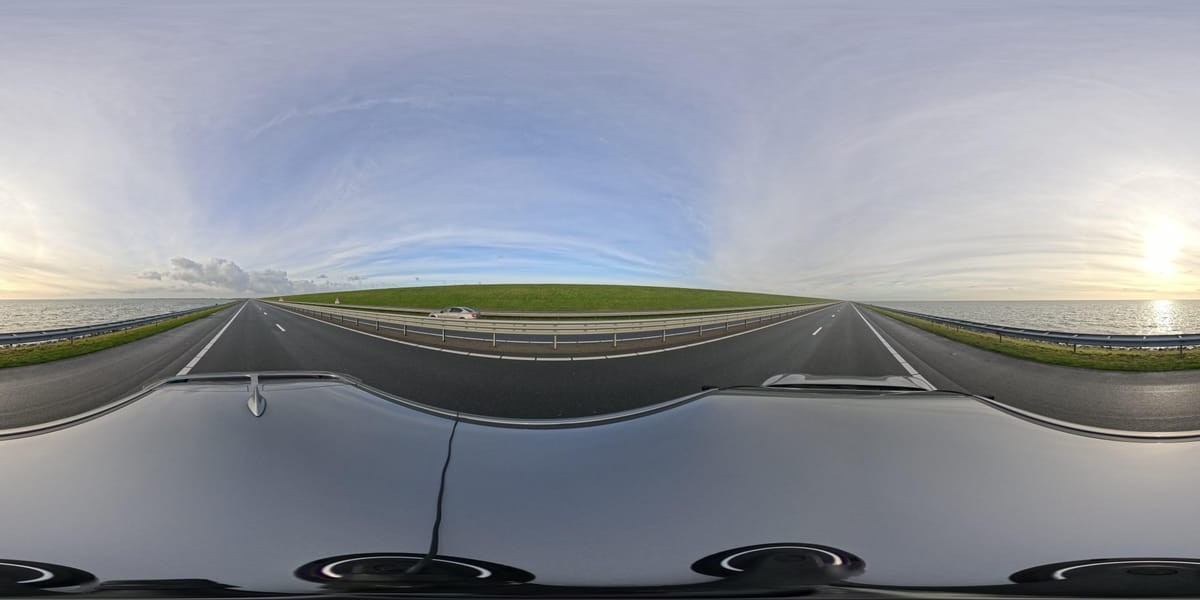
Use Quik or GoPro Player for the intended MAX2 export path and test optional Labs captures separately. The HDRI tool is designed around laptop/desktop processing. Theta X's ordinary JPEG and HDR-DNG routes likewise need separate pilot jobs: a successful phone connection does not prove a complete RAW-development workflow.
GoPro Player lists macOS 10.14 or Windows 10 and newer, with HEVC-capable graphics guidance, and supports batch export. Its HyperSmooth Pro feature explicitly excludes 360 content; do not confuse that desktop feature with MAX2's in-camera stabilization. A current MAX2-specific phone-performance baseline is not established here, and the manual warns that 8K phone playback, editing and sharing depend on the device.
Ricoh's HDR-DNG workflow identifies Lightroom Classic 13.5 as a confirmed RAW developer, not a guarantee for every later version. Develop to dual-fisheye JPEG or RGB TIFF, then run Stitcher. Preserve the original HDR-DNG and intermediate files independently of the hosted export, and include processing time when estimating a multi-room job.
Compare final equirectangular exports at a common viewing size, then inspect the hosted result. Preserve capture originals, processing intermediates and client exports as different assets. Do not substitute a third-party illustration for a matched room test.
Real estate, construction and travel decisions
Real estate: Theta X has the documented RAW-derived HDR-DNG route; MAX2 Labs JPEG bracketing is a different option with its own trigger and processing restrictions. Evaluate the completed interior and staff time before choosing either for an entire property portfolio.
Construction: MAX2's replaceable lenses and motion-video range may matter outdoors; Theta X's internal storage and still controls may matter for repeated room capture. Both have removable power and location hardware. Keep viewpoint IDs and processing consistent; see our construction-site virtual-tour workflow.
Travel: MAX2 offers the broader documented action-video range. Theta X can suit deliberate destination panoramas. For owner-operated Panorra, preserve the full sphere independently of social-video crops and test the final hosted export; no direct integration certification is claimed.
Read the MAX2 and Theta X guides, compare MAX2 vs Theta Z1 or DJI Osmo 360 vs MAX2, and browse the comparison directory. Use current complete-kit quotes and processing costs rather than an assumed permanent price winner.

_2025-11-02_08H30M14S000_(1546019943479385_at_S5wp7d3cHai9lgKELnOqAW)_taken_with_GoPro_MAX2.jpg)
Comments ()