DJI Osmo 360 vs Insta360 X4: Full Specs and Tour Workflows
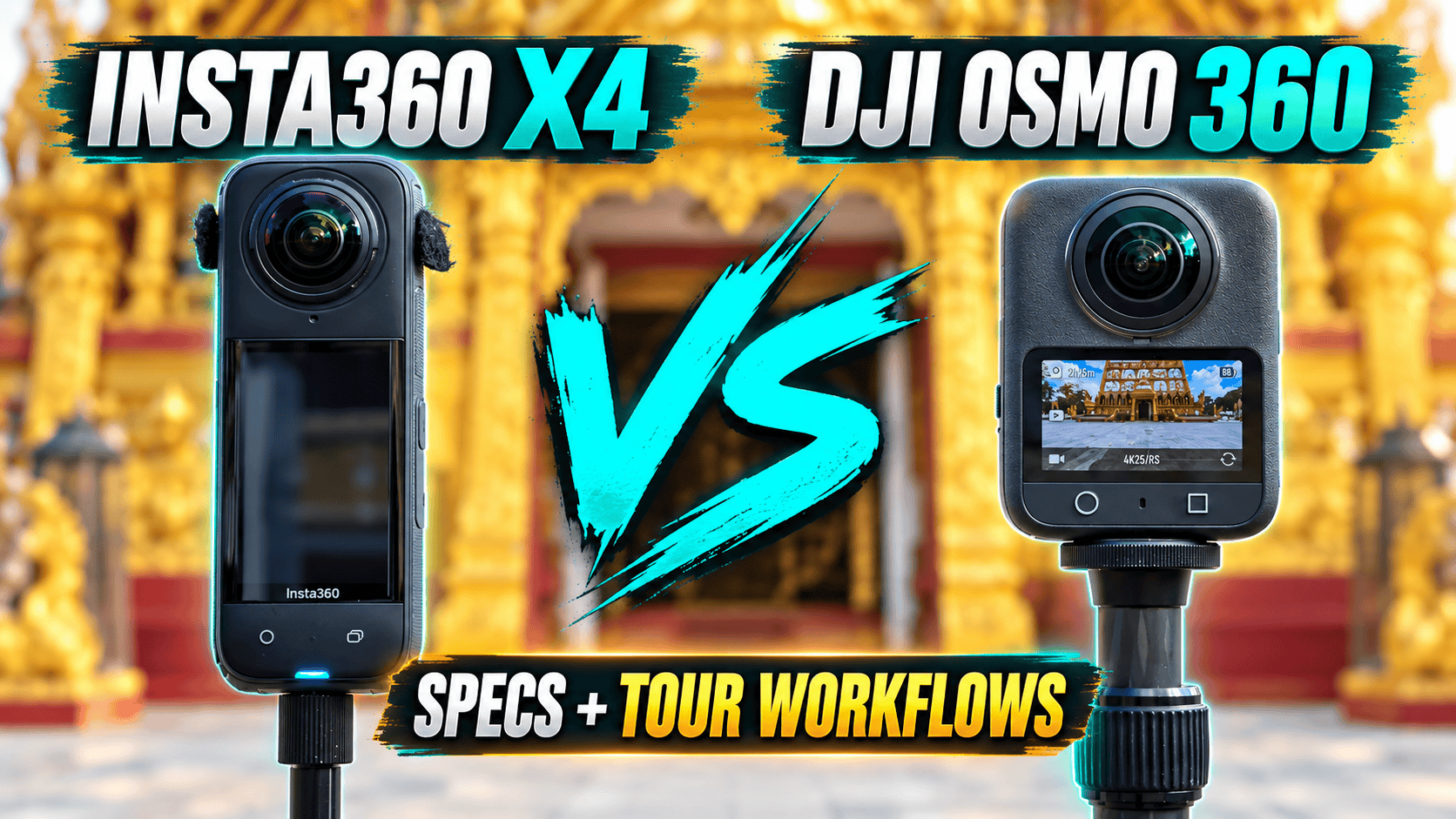
Technical head-to-head · Original Osmo 360 versus X4
Osmo 360 offers 8K50 spherical video, internal storage and larger listed JPEG panoramas. X4 offers an established DNG/AEB route, a taller touchscreen and a different selection of recording modes. For an X4 owner, the decision is whether DJI adds a needed deliverable—not whether both cameras carry an 8K label.
What does switching from X4 actually change?
Shortlist Osmo 360 for its particular video modes and internal storage. It records 7680 × 3840 spheres at up to 50 fps, where X4 reaches 30 fps. Internal storage provides another capture destination when a card is unavailable. Neither difference proves better finished interior panoramas.
Keep X4 in consideration when its still-processing path is important. Its DNG and 18 MP AEB workflow cannot be replaced merely by choosing a larger JPEG on DJI. Existing accessories, processing presets and staff familiarity also affect whether a change saves time.
If you already deliver satisfactory X4 tours, identify the missing requirement before replacing it. Compare a difficult room and a representative moving sequence, including stitching and export time. A manufacturer feature list can establish available controls, not the winner of those assignments.
Sensors, photo dimensions and exposure controls
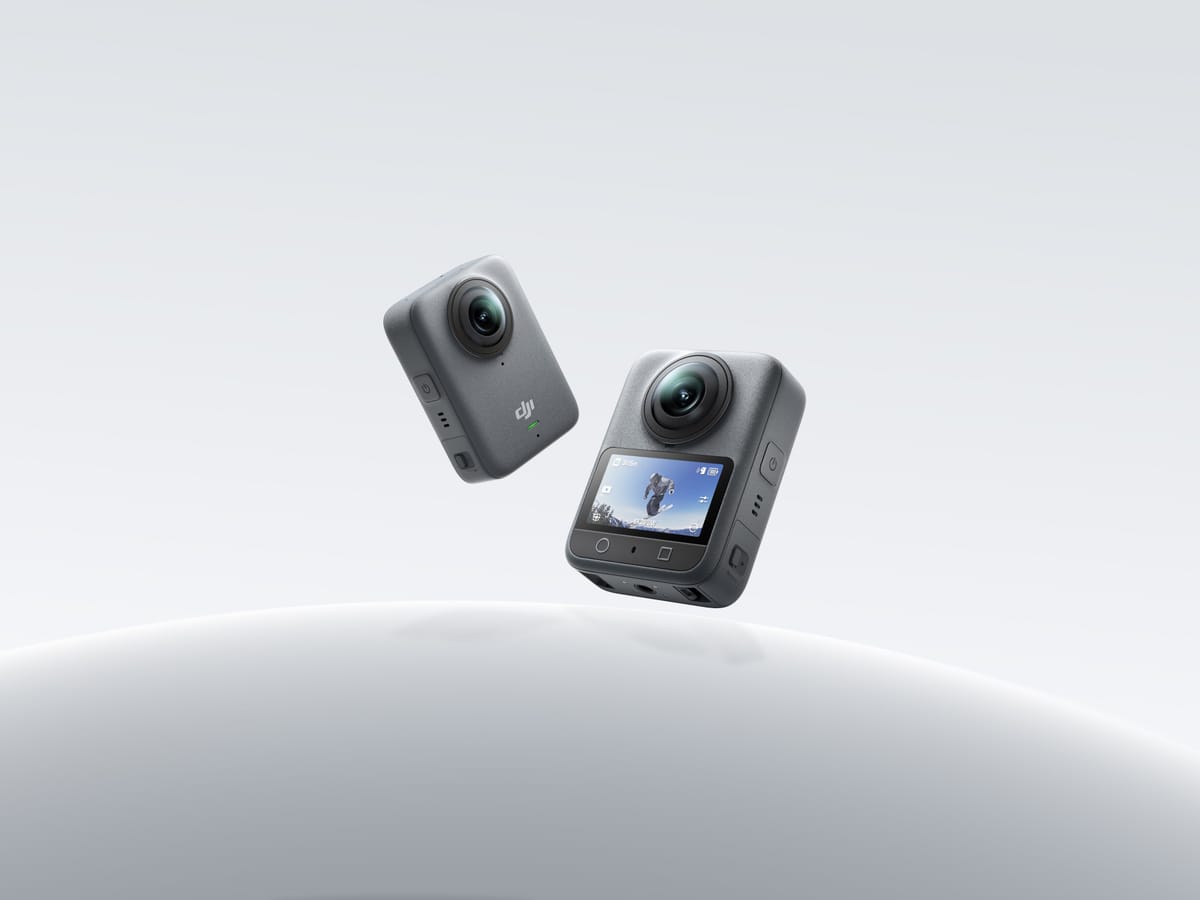
| Parameter | Osmo 360 | X4 |
|---|---|---|
| Sensor format | Two 1/ | 1/2-inch type |
| Aperture | f/1.9 | f/1.9 |
| Largest sphere | 15520 × 7760; 120 MP | 11904 × 5952; 72 MP |
| Other still sizes | Single-lens: 6400 × 4800 | 18 MP sphere: 5888 × 2944; single-lens: 5984 or 2976 square |
| Photo formats | JPEG in cited specifications | INSP, DNG; in-camera JPG option documented separately |
| ISO range | 100–51200 | 100–6400 |
| Manual shutter | 1/ | 1/ |
| Exposure adjustment | Numeric limits not established here | ±4 EV |
| Color temperature | Numeric limits not established here | 2000–10000 K |
| Minimum focus | 0.35 m | 0.6 m |
| Stitching clearance | At least 0.75 m | Equivalent numeric clearance not established |
Sources: DJI specifications, DJI FAQ, Insta360 shooting table, X4 column and hardware table. DJI's coverage marketing does not change its specified 1/1.1-inch sensor format. Minimum focus and stitching clearance answer different questions; neither is a safe distance for every close foreground object.
Largest listed panorama width
Osmo 360 — 15,520 pixels
X4 — 11,904 pixels
A larger JPEG does not replace an AEB workflow
| Route | Capture | Workflow |
|---|---|---|
| Osmo 360 still | JPEG with PRO exposure controls | Inspect the processed sphere and retain originals |
| X4 maximum size | 72 MP listed | Do not assume AEB at this size |
| X4 AEB | 18 MP HDR Photo, PureShot + RAW | Develop and inspect the bracketed output |
| Matched room test | Same viewpoint and lighting | Compare completed exports and operator time |
The shared Insta360 AEB guide excludes X4 AEB at 72 MP and directs users to 18 MP HDR Photo with PureShot + RAW. Listing “72 MP, RAW, HDR” together without this limitation would misrepresent the available combination. An equivalent DJI spherical DNG/AEB pipeline is not established by the cited JPEG specification.
For a real-estate trial, include bright windows, dark fabric, close furniture and motion near a seam. Compare finished spheres at the same viewing size. Record capture, processing and cleanup time separately; neither a larger sensor-format label nor a RAW file extension guarantees the better accepted deliverable.
8K50 versus 8K30, with different intermediate modes
| Parameter | Osmo 360 | X4 |
|---|---|---|
| 8K: 7680 × 3840 | 24, 25, 30, 48, 50 fps | 24/25/30 fps |
| Intermediate size | 6000 × 3000 at 24, 25, 30, 48, 50, 60 fps | 5760 × 2880 at 24, 25, 30, 50, 60 fps |
| 5.7K+ mode | Equivalent plus mode not listed | 5760 × 2880 at 24/25/30 fps |
| 4K: 3840 × 1920 | 100 fps | 24, 25, 30, 50, 60, 100 fps |
| Recording files | OSV panorama; MP4/HEVC flat | INSV sphere; H.264/H.265 |
| Maximum bitrate | 170 Mbps | 200 Mbps |
| Color pipeline | 10-bit / D-Log M documented | Standard, Vivid, Flat |
| Low-light mode | SuperNight sphere: 8K/6K at 24/25/30 | PureVideo not listed |
| Audio format | 48 kHz, 16-bit AAC; four microphones | 48 kHz, 16-bit AAC; stereo and direction-focus options |
DJI's product overview documents 10-bit and D-Log M. Check the actual mode and export rather than interpreting X4's Flat profile as the same log pipeline. X4's higher maximum bitrate does not establish better compression quality; DJI's higher ISO ceiling does not establish cleaner footage.
For travel footage, 8K50 can offer a different motion or slowdown option from 8K30, but exposure time, heat and storage requirements still matter. Both cameras list the same 3840 × 1920 full-sphere size at 100 fps. A reframed forward-facing crop uses only part of those pixels.
Flat clips, slow motion and time sequences
X4's shared HDR guide treats Active HDR as a separate shooting mode on X4/X3, unlike the controls described for newer models. Do not apply X5 or X4 Air limits to X4, or assume ordinary 8K settings apply to Active HDR. A complete X4 Active HDR resolution/rate matrix is not established here.
DJI ordinary single-lens video lists 5120 × 3840 or 5120 × 2880, 3840 × 2880 or 3840 × 2160, and 2688 × 2016 or 2688 × 1512, all at 25/30/50/60 fps. Boost extends the 4K/2.7K sizes to 100/120 and adds 2160 × 3840 or 1512 × 2688 portrait output. Single-lens SuperNight uses landscape 4K/2.7K at 25/30.
X4 ordinary flat video lists 3840 × 2160, 2720 × 1536 or 1920 × 1080 at 24/25/30/50/60 fps. FreeFrame lists 3840 square at 24/25/30, with 2720 and 1920 square adding 48/50/60. Me Mode lists 3840 × 2160 at 24/25/30 or 2720 × 1536 and 1920 × 1080 at 50/60/100/120. These are different file geometries, not interchangeable labels.
DJI Selfie lists 3840 square at 25/30/50/60, 3000 square adding 100/120, and 1920 square at 100/120/240. Vortex instead lists 6000 × 1500 at 100/120 or 3840 × 960 at 240. X4's product page advertises Bullet Time at 5.7K120 or 3K240; exact output dimensions are not established here. A narrow Vortex frame is not a full 2:1 sphere.
DJI timelapse produces 8K25/30 with capture intervals from one second to 60 minutes; Hyperlapse offers Auto or 2/5/10/15/30×. X4's timelapse guide lists 11K/8K/5.7K at 30 fps with resolution-dependent intervals. Neither timelapse ceiling should be presented as ordinary video capability. Preserve dated still panoramas separately from site-progress clips.
DJI documents RockSteady 3.0 and HorizonSteady; panoramic stabilization is selected during Mimo export. Single-lens HorizonSteady is restricted to standard-view, distortion-corrected 16:9 video up to 60 fps. X4 documents FlowState and horizon lock. Those feature names are not a matched walking-stabilization result.
DJI's exact timelapse intervals are 1/2/3/4/5/6/8/10/15/20/25/30/40 seconds or 1/2/5/30/60 minutes. Duration options are 5/10/20/30 minutes, 1/2/3/5 hours or unlimited. Pre-REC offers 5/10/15/30 seconds or 1/2/5 minutes; its separate single-lens livestream output is 1920 × 1080 at 30 fps.
X4 timelapse intervals are 0.5/1/2/5/10/30/60/120 seconds, depending on resolution. Its guide's high-resolution question excludes one second while the answer describes intervals below one second; confirm the actual 8K/11K menu setting. Capture interval, playback frame rate and pre-recording buffer describe different controls.
Internal storage, power and field protection
| Parameter | Osmo 360 | X4 |
|---|---|---|
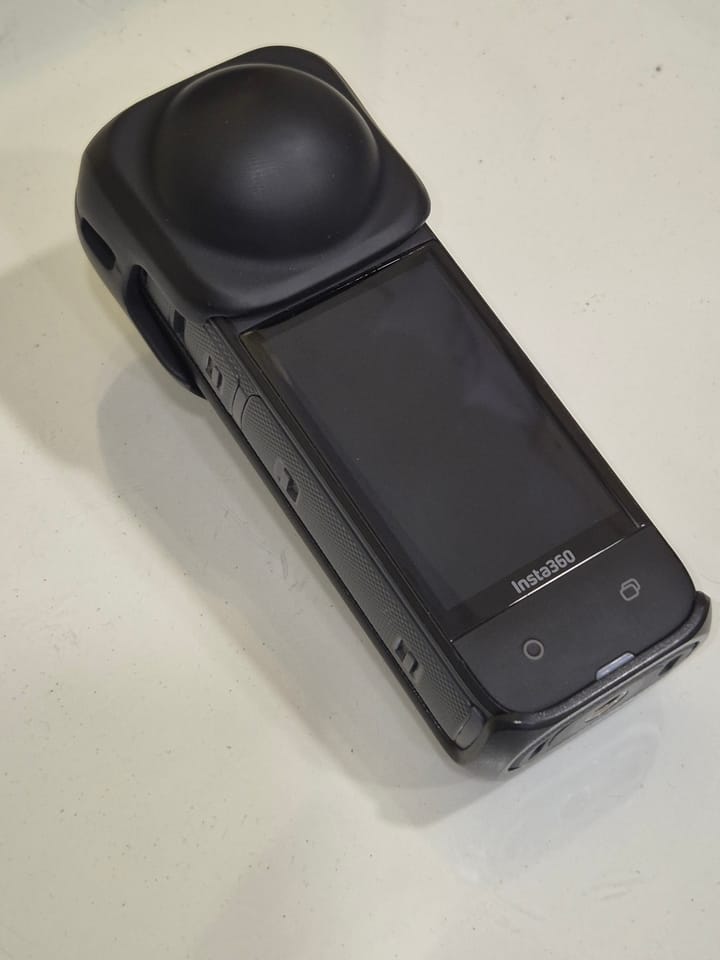
| Weight | 183 g | 203 g |
| Dimensions | 61 × 36.3 × 81 mm, L×W×H | 46 × 123.6 × 37.6 mm, W×H×D |
| Touchscreen | 2-inch OLED; 314 × 556 | 2.5-inch LCD; 440 × 696 |
| Removable battery | 1950 mAh | 2290 mAh |
| Internal storage | 128 GB nominal; 105 GB usable | Recording relies on microSD |
| Card support | microSD up to 1 TB; exFAT | UHS-I V30, exFAT, up to 1 TB |
| USB | Type-C 3.1 | Type-C 3.0 |
| Bluetooth | BLE 5.1 | BLE 5.2 |
| Operating range | −20–45°C | −20–40°C |
| Body water rating | IP68; 10 m | 10 m |
| Lens maintenance | Not user-changeable per FAQ | Removable guards, not lens replacement |
DJI quotes 100 minutes at 8K30 or 120 with Endurance enabled, and 190 at 6K24 Endurance under its specified 25°C/screen-off/wireless-off conditions; EU/UK behavior can differ. X4 quotes 75 minutes at 8K30 or 135 at 5.7K30 with High bitrate, screen off, Wi-Fi Auto and AI Highlights off at 25°C. These are different manufacturer methods, not proof of a percentage runtime advantage.
X4's storage guide excludes UHS-II/UHS-III cards and capacities above 1 TB. DJI's internal memory is a capture destination, not an independent backup. Test the specific card and preserve a verified second copy before erasing originals.
Neither 10 m body rating guarantees clean underwater stitching. DJI warns against bare-camera underwater capture, and Insta360 directs underwater spherical capture to its Invisible Dive Case. Guards protect surfaces but do not create user-replaceable lenses. Check support clearance and cable access before field deployment.
DJI's FAQ supports PD 3.0 charging with a 30 W-or-higher source and both the 1950 mAh Extreme Battery Plus and 1770 mAh Extreme Battery. A full-charge time is not established here. X4's hardware guide quotes approximately 38 minutes to 80% or 55 to full at 9 V/2 A, camera off at 25°C with its specified 30 W PD 3.0 PPS charger. These are not matched charging measurements.
DJI lists Wi-Fi 6 with a/b/g/n/ac/ax protocols. X4's product page lists 5 GHz a/n/ac, while its shared hardware table also includes b/g; check regional connection behavior rather than silently combining the two lists. Osmo 360 has quick-release mounting and a bottom 1/4-inch screw hole. DJI recommends keeping the camera and invisible stick aligned; tilted or offset mounting can interfere with stick removal.
Compare the complete software and delivery path
DJI Mimo/Studio and Insta360 app/Studio are different processing environments. Test the original OSV or INSV file, then the intended export. A successful phone connection does not establish smooth long-form 8K editing. DJI supports Mimo or USB transfer from internal and card storage; a card reader reaches only the card.
For still tours, retain capture originals, processing masters and hosted exports separately. Inspect orientation, seams, color and load behavior at the intended viewing size. Evaluate X4's AEB/RAW route separately from ordinary still capture, and do not assume a JPEG-only DJI specification supplies an equivalent workflow.
Current requirements should be checked against the DJI downloads and X4 product/support pages before committing to a phone or workstation. No complete GoThru or Panorra compatibility certification is claimed by this specification comparison.
At this check, DJI lists Mimo 2.12.0 for iOS 15 or Android 9 and newer. Studio 1.2.11 supports macOS 11 on M1 or newer, or Windows 10 and newer, and recommends at least 16 GB RAM plus suitable CPU/GPU hardware. These baselines do not guarantee smooth 8K editing or every optional feature.
X4's product page lists A12/iOS 13 or newer, or supported Snapdragon 855, Kirin 990 and Exynos 2200-class devices with Android 10/HarmonyOS 2 or newer. Installation requires a 64-bit phone system; SDM765 5G is excluded for decoding limitations. Check the current app and representative exports before replacing an otherwise functional capture system.
Real estate, construction and travel decisions
Real estate: X4's 18 MP AEB/PureShot + RAW route addresses a different editing need from DJI's 120 MP JPEG maximum. Compare completed difficult rooms and staff time, not unrelated maximum-resolution and format labels.
Construction: DJI's internal storage can help if a card is unavailable; both cameras have removable power. Preserve consistent viewpoints, dates and processing settings. See the construction-site virtual-tour workflow. Neither camera is presented as calibrated survey equipment.
Travel: consider DJI's 8K50 and flat-video options against the X4 equipment and editing workflow you already use. Preserve destination spheres for owner-operated Panorra separately from social crops. Obtain current full-kit prices before assuming either camera is the cheaper system.
Read the Osmo 360 and X4 guides, compare Osmo 360 vs X5 or X4 vs X5, and browse the comparison directory.

Comments ()