DJI Osmo 360 vs Insta360 X3: Full Specs and Upgrade Tradeoffs
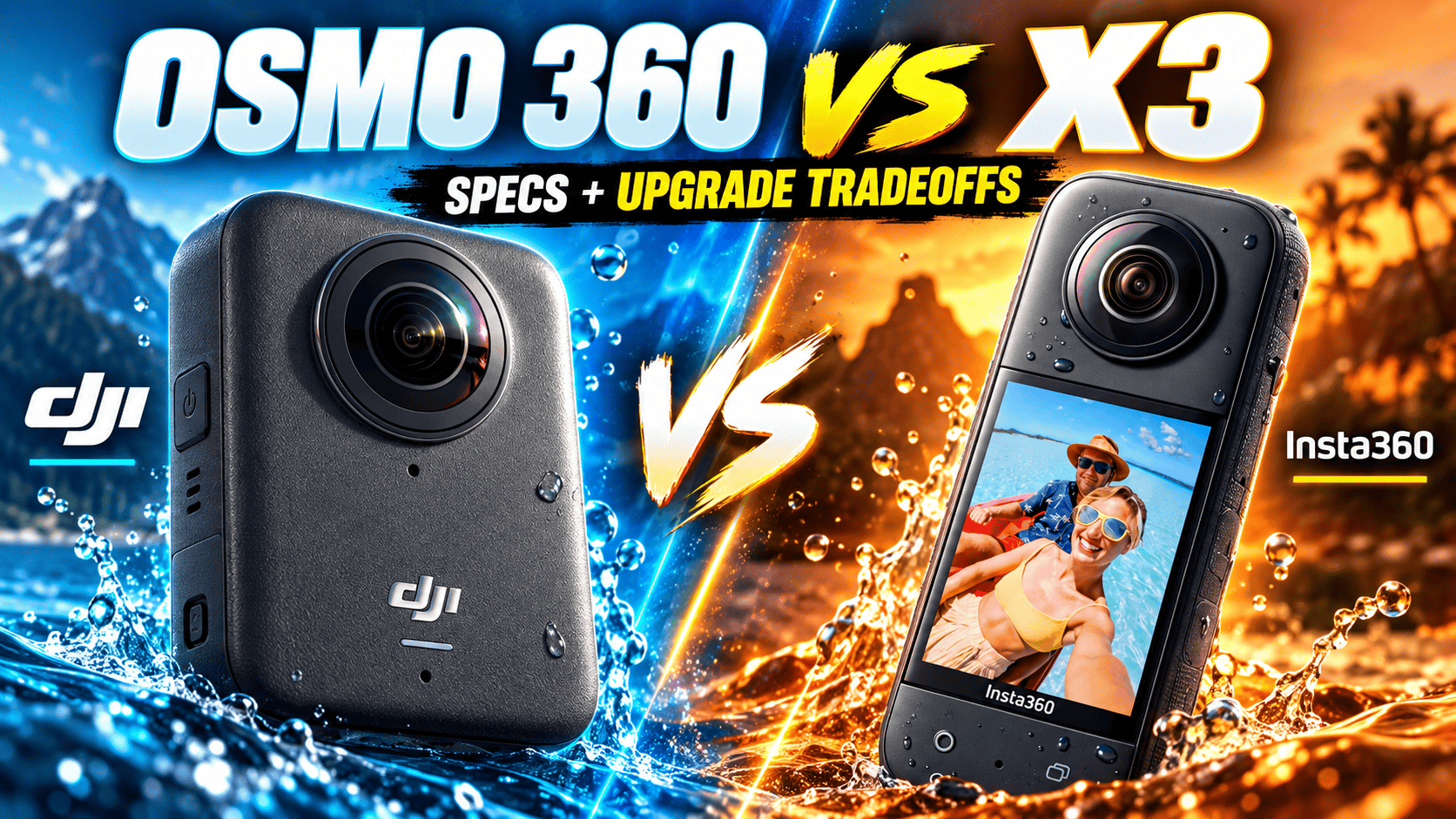
Technical head-to-head · Moving from X3 to original Osmo 360
Osmo 360 adds ordinary 8K50 video and internal storage to this comparison. X3 offers a different RAW/HDR still workflow and may already fit an established virtual-tour process. For an X3 owner, the useful question is which missing deliverable justifies changing systems.
A video upgrade is not automatically a tour-photo upgrade
Shortlist Osmo 360 for its broader video range and internal storage. Ordinary 8K50 and flat 5K modes cover outputs beyond X3's ordinary 5.7K30 sphere and flat 4K30. Internal storage offers another capture destination when a card is unavailable, though it is not an independent backup.
Keep X3 in consideration when its existing still workflow meets the job. Its DNG/PureShot route and 18 MP HDR Photo mode address different processing needs from DJI's JPEG specification. A larger JPEG does not replace exposure control or prove cleaner window detail.
Before changing systems, compare a representative room and moving sequence. Include transfer, processing, seam inspection and delivery time. Budget accessories and retraining as well as the camera; no permanent price advantage is assumed.
Sensors, photo dimensions and exposure controls
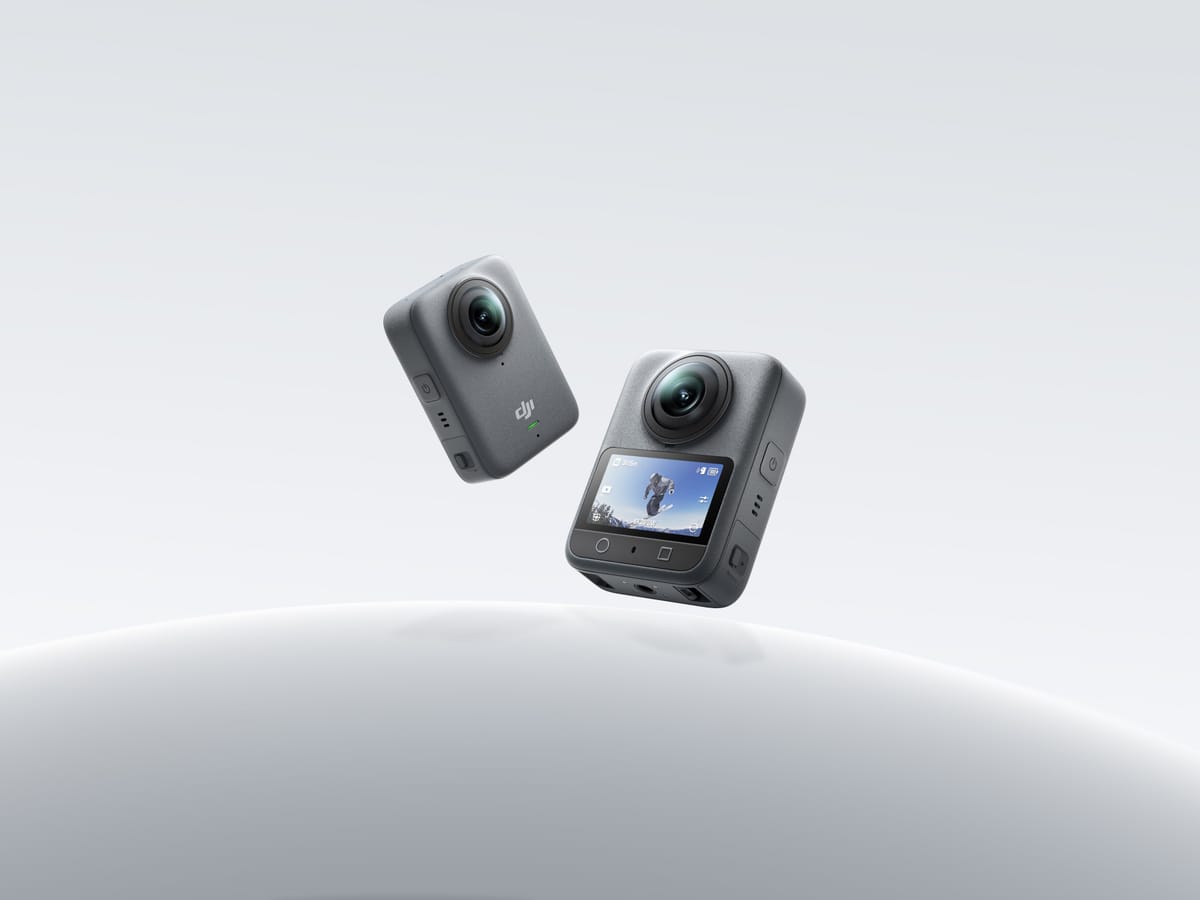
| Parameter | Osmo 360 | X3 |
|---|---|---|
| Sensor format | Two 1/ | 1/2-inch type |
| Aperture | f/1.9 | f/1.9 |
| Largest sphere | 15520 × 7760; 120 MP | 11968 × 5984; 72 MP |
| Other still sizes | Single-lens: 6400 × 4800 | 18 MP sphere: 5952 × 2976; single-lens: 5984 or 2976 square |
| Photo formats | JPEG in cited specifications | INSP, DNG |
| ISO range | 100–51200 | 100–3200 |
| Manual shutter | 1/ | 1/ |
| Exposure adjustment | Numeric limits not established here | ±4 EV |
| Color temperature | Numeric limits not established here | 2000–10000 K |
| Minimum focus | 0.35 m | 0.3 m |
| Stitching clearance | At least 0.75 m | Equivalent numeric clearance not established |
Sources: DJI specifications, DJI FAQ, Insta360 shooting table, X3 column and hardware table. DJI's coverage marketing does not change its specified 1/1.1-inch sensor format. Minimum focus and stitching clearance answer different questions; neither is a safe distance for every close foreground object.
Largest listed panorama width
Osmo 360 — 15,520 pixels
X3 — 11,968 pixels
Compare the actual still-production route
| Route | Capture | Workflow |
|---|---|---|
| Osmo 360 | JPEG; PRO controls | Inspect processed spheres and retain originals |
| X3 ordinary | 72 or 18 MP | Check selected format and export settings |
| X3 HDR Photo | 18 MP per model-specific guide | Bracket count/step matrix not established here |
| X3 PureShot | RAW processing route | Shared guide specifies desktop Studio processing |
X3's parameter manual limits HDR Photo, Burst and Starlapse to 18 MP. Its 72 MP maximum must not be combined with every listed photo feature as though all work simultaneously.
An equivalent DJI spherical DNG/AEB pipeline is not established by its cited JPEG specification. Test bright windows, dark materials and movement near seams, then compare completed spheres at a common viewing size. Time development and cleanup separately from capture. Neither the maximum JPEG size nor a RAW extension decides the winner.
Ordinary 8K50 versus 5.7K30
| Parameter | Osmo 360 | X3 |
|---|---|---|
| 8K: 7680 × 3840 | 24, 25, 30, 48, 50 fps | Not ordinary video |
| Intermediate size | 6000 × 3000 at 24, 25, 30, 48, 50, 60 fps | 5760 × 2880 at 24/25/30 fps |
| Other ordinary mode | See modes above | 3008 × 1504 at 100 fps |
| 4K: 3840 × 1920 | 100 fps | 24, 25, 30, 50, 60 fps |
| Recording files | OSV panorama; MP4/HEVC flat | INSV sphere; H.264 |
| Maximum bitrate | 170 Mbps | 120 Mbps |
| Color pipeline | 10-bit / D-Log M documented | Standard, Vivid, LOG |
| Low-light mode | SuperNight sphere: 8K/6K at 24/25/30 | PureVideo not listed |
| Audio format | 48 kHz, 16-bit AAC; four microphones | 48 kHz, 16-bit AAC; stereo and direction-focus options |
DJI's product overview documents 10-bit and D-Log M. Check the actual mode and export rather than treating X3's LOG profile as the identical pipeline. DJI's higher maximum bitrate does not establish better compression quality, and its higher ISO ceiling does not establish cleaner footage.
DJI adds ordinary 8K50 where X3 tops out at 5.7K30. At 100 fps, DJI lists 3840 × 1920 while X3 lists 3008 × 1504. Those capture differences are not matched quality scores; a reframed forward-facing crop contains only part of the source pixels. The shared X3 table lists broader 4K frame rates than its model-specific guide, which lists 30/60; verify the intended firmware and setting.
Flat clips, slow motion and time sequences
DJI ordinary single-lens video lists 5120 × 3840 or 5120 × 2880, 3840 × 2880 or 3840 × 2160, and 2688 × 2016 or 2688 × 1512, all at 25/30/50/60 fps. Boost extends the 4K/2.7K sizes to 100/120 and adds 2160 × 3840 or 1512 × 2688 portrait output. Single-lens SuperNight uses landscape 4K/2.7K at 25/30.
X3 lists 3840 × 2160 at 24/25/30; 3584 × 2016, 2720 × 1530 and 1920 × 1088 add 50/60. These flat sizes must not be mixed with the full-sphere table.
X3's model-specific guide distinguishes default-FOV video, where FlowState can be applied in camera, from FOV+ video, where FlowState, aspect ratio and horizon lock use app/Studio processing. FOV+ lists 2.7K or 1080p at 24/25/30/50/60; do not extend it to every ordinary single-lens size. The same distinction applies to its loop-recording modes.
DJI Selfie lists 3840 square at 25/30/50/60, 3000 square adding 100/120, and 1920 square at 100/120/240. Vortex uses 6000 × 1500 at 100/120 or 3840 × 960 at 240, not a full 2:1 sphere.
X3's parameter guide lists Active HDR and TimeShift at 5.7K24/25/30, Bullet Time at 4K120 or 3K180, and timelapse playback at 8K or 5.7K24/25/30. Its 8K timelapse is not ordinary 8K motion recording. Model-specific Me Mode lists 1080p30/60 despite the shared table's contradictory unsupported entry.
DJI timelapse produces 8K25/30 playback; Hyperlapse offers Auto or 2/5/10/15/30×. X3 interval stills offer 72 or 18 MP at 3/5/10/30/60/120-second spacing. Preserve dated panoramas separately from accelerated site-progress clips.
DJI documents RockSteady 3.0 and HorizonSteady; panoramic stabilization is selected during Mimo export. Single-lens HorizonSteady is restricted to standard-view, distortion-corrected 16:9 video up to 60 fps. X3 documents FlowState and horizon lock. Those feature names are not a matched walking-stabilization result.
DJI's exact timelapse intervals are 1/2/3/4/5/6/8/10/15/20/25/30/40 seconds or 1/2/5/30/60 minutes. Duration options are 5/10/20/30 minutes, 1/2/3/5 hours or unlimited. Pre-REC offers 5/10/15/30 seconds or 1/2/5 minutes; its separate single-lens livestream output is 1920 × 1080 at 30 fps.
X3's timelapse capture intervals are 0.2/0.5/1/2/4/10/30/60/120 seconds. Loop recording offers 1/3/5/10/15/20/25/30-minute durations. Its shooting FAQ limits 15/30-second pre-recording to ordinary 360 and single-lens Video, rather than all special modes, and excludes HDMI output. Capture interval, playback rate and retained loop duration are distinct controls.
Internal storage, power and field protection
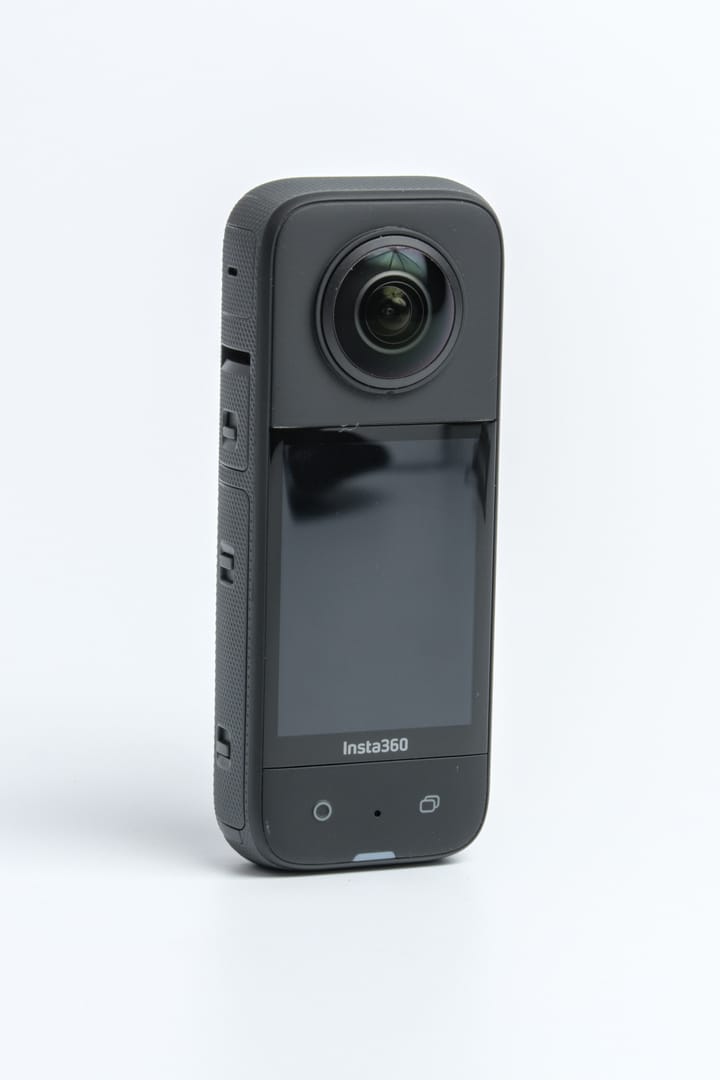
| Parameter | Osmo 360 | X3 |
|---|---|---|
| Weight | 183 g | 180 g |
| Dimensions | 61 × 36.3 × 81 mm, L×W×H | 46 × 114 × 33.1 mm, W×H×D |
| Touchscreen | 2-inch OLED; 314 × 556 | 2.29-inch LCD; 344 × 476 |
| Removable battery | 1950 mAh | 1800 mAh |
| Internal storage | 128 GB nominal; 105 GB usable | Recording relies on microSD |
| Card support | microSD up to 1 TB; exFAT | UHS-I V30, exFAT, up to 1 TB |
| USB | Type-C 3.1 | Type-C 2.0 |
| Bluetooth | BLE 5.1 | 5.0 |
| Operating range | −20–45°C | −20–40°C |
| Body water rating | IP68; 10 m | 10 m |
| Lens maintenance | Not user-changeable per FAQ | Sticky guards protect rather than replace lenses |
DJI quotes 100 minutes at 8K30 or 120 with Endurance, and 190 at 6K24 Endurance under specified 25°C, screen-off and wireless/control-off conditions; EU/UK behavior can differ. X3 quotes 81 minutes at 5.7K30 with High bitrate, screen off and Wi-Fi Auto at 25°C. These different workloads do not establish a percentage endurance advantage for still tours.
X3 recommends UHS-I V30 cards in exFAT up to 1 TB. DJI internal memory is a capture destination, not an independent backup. Test sustained recording with the chosen card and retain a verified second copy before erasing originals.
Neither 10 m body rating guarantees clean underwater stitching. DJI warns against bare-camera underwater capture; assess the appropriate X3 dive housing for that work. Guards protect surfaces but do not create user-replaceable lenses. Check support clearance and cable access before field deployment.
DJI supports PD 3.0 charging with a 30 W-or-higher source and both the 1950 mAh Extreme Battery Plus and 1770 mAh Extreme Battery. A full-charge time is not established here. X3 quotes approximately 90 minutes at 5 V/3 A under camera-off, 25°C conditions. These are not matched charging measurements.
DJI lists Wi-Fi 6 with a/b/g/n/ac/ax; X3 lists 2.4/5 GHz a/b/g/n/ac. Osmo 360 has quick-release mounting and a bottom 1/4-inch screw hole; align the camera and invisible stick to avoid interfering with stick removal. X3 mounting-thread details are not established here: check the actual support and power access.
Compare the complete software and delivery path
DJI Mimo/Studio and Insta360 app/Studio are different processing environments. Test the original OSV or INSV file, then the intended export. A successful phone connection does not establish smooth long-form 8K editing. DJI supports Mimo or USB transfer from internal and card storage; a card reader reaches only the card.
For still tours, retain capture originals, processing masters and hosted exports separately. Inspect orientation, seams, color and load behavior at the intended viewing size. Evaluate X3's HDR/PureShot route separately from ordinary still capture, and do not assume a JPEG-only DJI specification supplies an equivalent workflow.
Current requirements should be checked against the DJI downloads and X3 product/support pages before committing to a phone or workstation. No complete GoThru or Panorra compatibility certification is claimed by this specification comparison.
At this check, DJI lists Mimo 2.12.0 for iOS 15 or Android 9 and newer. Studio 1.2.11 supports macOS 11 on M1 or newer, or Windows 10 and newer, and recommends at least 16 GB RAM plus suitable CPU/GPU hardware. These baselines do not guarantee smooth 8K editing or every optional feature.
X3's product compatibility list starts at A11/iOS 13, with Android examples including Snapdragon 845, Kirin 980, Exynos 9810 and Tensor Pixel 6. It requires a 64-bit phone system and excludes SDM765 5G; Snap Wizard has a separate higher requirement. Wireless iOS/Android use is supported, but wired iOS connection is explicitly excluded. Its optional microphone adapter provides a separate 3.5 mm input route.
DJI's downloads page lists separate optional desktop plug-ins rather than a single universal editing path. Its DaVinci Resolve plug-in requires Resolve 20.0.1 or later and preprocessing in DJI Studio using the dedicated Resolve export format; listed systems include macOS 15 or Windows 10 64-bit 22H2/Windows 11. Budget this preprocessing step if Resolve is central to delivery instead of assuming the OSV original drops straight into an identical workflow.
Real estate, construction and travel decisions
Real estate: compare DJI JPEG capture against X3's actual 18 MP HDR/PureShot route. The 120-versus-72 MP headline cannot settle difficult-room quality. Keep a satisfactory process unless a tested replacement fixes a specific problem.
Construction: DJI's internal storage can help if a card is unavailable; both cameras have removable power. Preserve consistent viewpoints, dates and processing settings. See the construction-site virtual-tour workflow. Neither camera is presented as calibrated survey equipment.
Travel: DJI adds ordinary 8K and flat 5K options; X3 still covers conventional panoramas and special slow motion. Preserve destination spheres separately from social crops for owner-operated Panorra. Compare current complete-kit quotes rather than assuming a permanent price winner.
Read the Osmo 360 and X3 guides, compare Osmo 360 vs X5 or X3 vs X4, and browse the comparison directory.

Comments ()